Founder's Speech on the Launch of Homodoxy
There is ample space and I believe great need for a press whose task is to attend to the spiritual and theological vibrancy of gay, lesbian, trans, and queer peoples as an act of healing the silencing of our histories and healing ourselves. Homodoxy will do that.
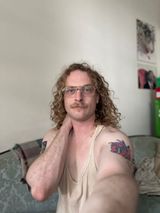
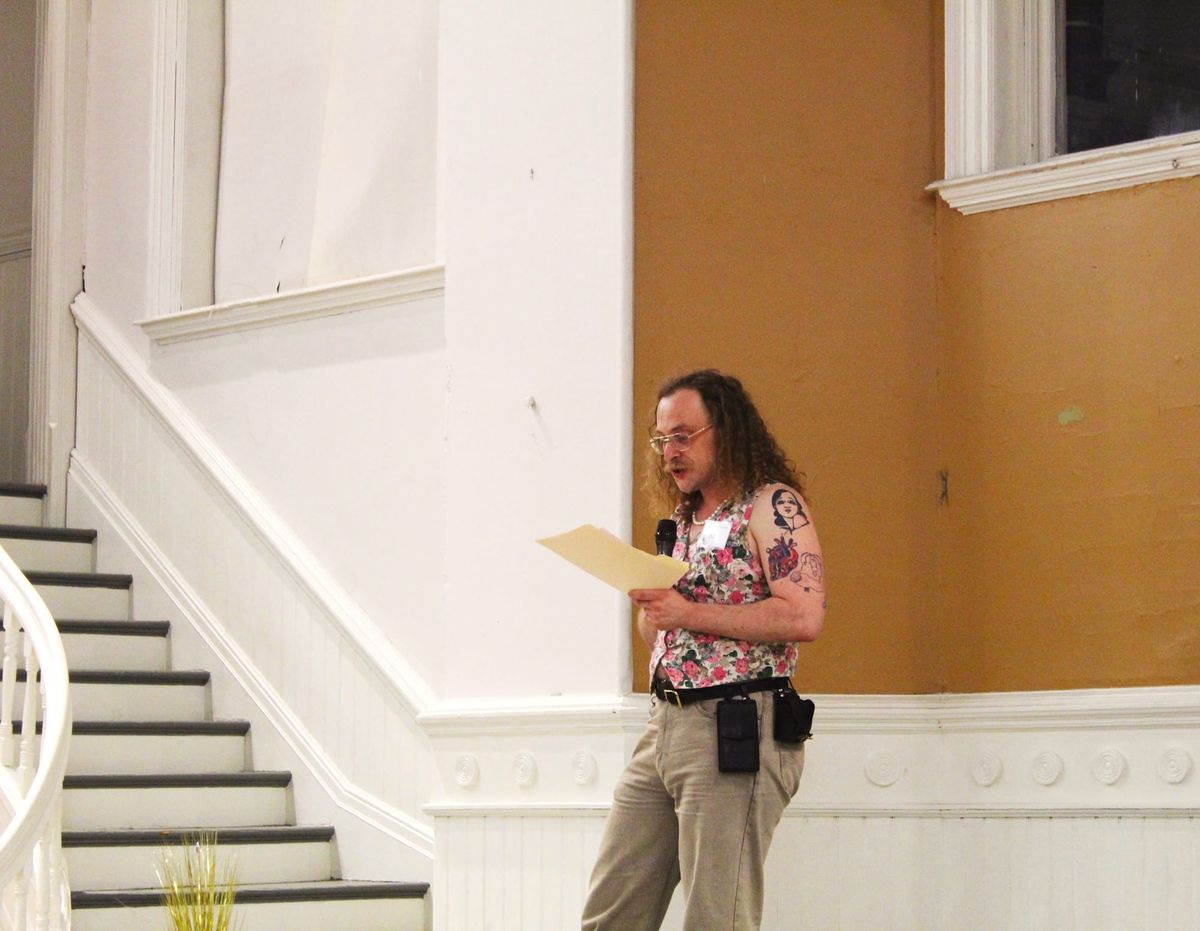
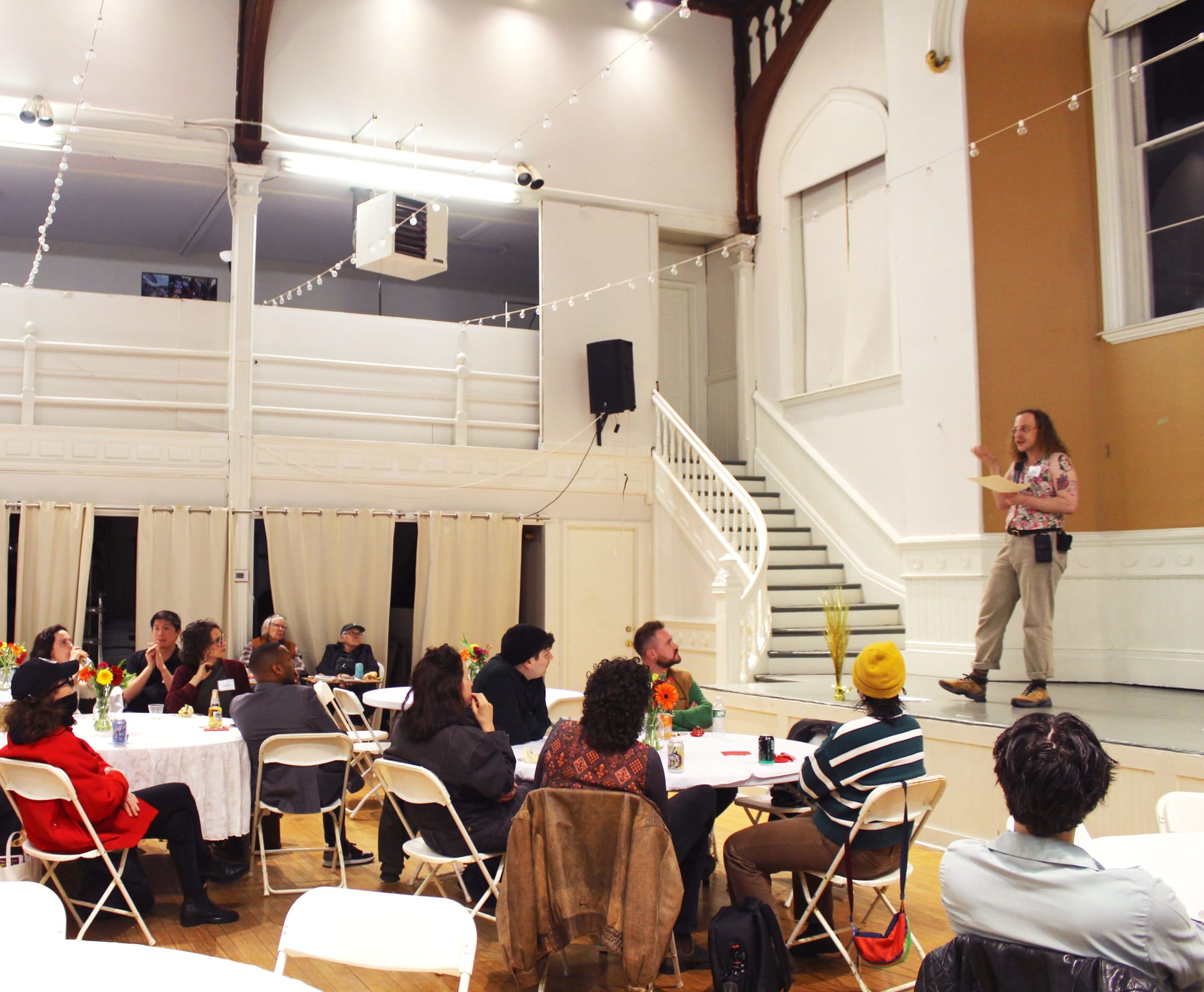
I gave this speech at the reception for the Judy Grahn + Rozalija Grace reading at the Episcopal Church of Saint Paul and Saint James on April 25, which also served as a celebration and hard launch of Homodoxy. I've edited it slightly.
A massive thank you to the Tsai Center for Innovative Thinking at Yale, the Community Foundation for Greater New Haven, and Wesleyan University for sponsoring the reception, and to the Fetzer Institute for filming it for their forthcoming documentary about the press.
As you may have pieced together by now, I’m starting a press for gay/queer/trans theology and literature called Homodoxy. For books that are too free for academic presses, too true to queer lives for traditional religious presses, and more focused on matters of spirituality and transcendence than its sibling queer presses.
Homodoxy will reintroduce older texts that are now hard to find and publish new queer writing in all genres and from a variety of religions, traditions, spiritual backgrounds, etc.
Queers often exist at the edges of our faith communities, or beyond them. A lot of publishing on faith and sexuality intends to draw us back into the center through antihomophobic readings of scripture and tradition and arguments for gay marriage and a lot of other publishing on faith and sexuality tries to push us further out of our communities of origin.
More happens on the margins than wailing and gnashing of teeth
I’ve been a student of queer theology for the past ten years. From scholars I admire, like Linn Tonstad and Mark Jordan, I learned that queer people do not need to continue arguing for our place at the table. Approaching questions of sex, gender, and faith as matters of inclusion and exclusion is a profoundly limiting way to speak about the real lives of complex and beautiful people. And when I speak about “inclusion” or “exclusion,” I mean the extent to which queers are allowed to participate fully in the life of the church, the synagogue, the mosque, the academy, etc. If inclusion can be won, most times, it comes at a profound cost: we must fit our lives into languages and relationships that might not actually fit us or be good for us. Exclusion, on the other hand, might mean greater freedom in how we live life, but for some, that newfound freedom is paired with a haunting sense of loss.
More happens on the margins than wailing and gnashing of teeth. Gays, lesbians, trans, and queer people find each other on the margins of our faith traditions. We find each other: we find friends and lovers of other backgrounds. We forge relationships that are not easy to account for in the terms of our home traditions. So, we get creative. Some of us become syncretists, some put their origins aside and attempt to start anew, while others return to the theology they’ve inherited with new eyes and newly significant bodies. When followed and embraced, queer desires become something of an ecumenical spiritual force.
In my own work as a Christian theologian, historian, and writer, I’ve been interested in how gay men in the 1960s and 70s formed new communities that became the locations from which they asked questions of who God is, what it means to live together, and what their bodies and desires mean. I am interested in Christianity not as a form of life or a culture imposed on gay men but as a practice of gay men—an encounter with God that places creative strains on the ways we live and love.
When I came out in college, a Christian college, I did not know that there were generations of gays who had already been living faithfully in new gay ways. I became interested in why it was the case that I didn’t know that history and why I couldn’t find it when I needed it. It became a professional interest.
There are several reasons the history of gay theology is difficult to find. (Take notes.)
- The relationship between queer people and the institutions that preserve cultural history—like the academy, publishing houses, and faith institutions—has most often been a bad one. The earliest gay and lesbian theologians could not get teaching jobs at universities. Their work was by and large turned down by academic and religious presses, and when published, it was panned as unserious, unreligious, what have you. So, they made institutions of their own to promote their work.
- The second reason the history of gay theology is difficult to find is that the institutions they built (presses, experiments in education outside of the university, new religious institutions) are often ephemeral. They are built quickly, and they disappear quickly. They burn bright, illuminating the world for those who participate, and then they burn out. They do, however, leave traces—signs of life and activity. That leads us to
- The forms that theological and spiritual LGBTQ writing takes are diverse and often also ephemeral. They are zines, flyers, signs at protests, the only poem someone published in a journal that put out four issues, letters to the editors, articles by clergy and former clergy in gay liberation newspapers. If you are not specifically looking for them, you’re unlikely to find them. The books go out of print and become collector’s items, or they are thrown out by a lover in grief when their creator dies, or they are misrecognized as junk by people who buy up estates. Slowly, the number of remaining copies dwindles down to the few that make it onto the shelves of a good used bookstore.
- These various forms of writing do not always make it into archives. Some do, but a university or library archive is not an obvious place to look if one is not trained in academic or journalistic research methods. Many archives are by intention or by accident inaccessible to people without university affiliation or without the know-how or money to get around that—money to pay for scans, to pay for flights and hotel reservations to visit the archives.
- Once in the archives, not a whole lot of people go looking for them.
- In the 1980s and 90s, AIDS and cancer killed many people doing this spiritual labor.
- We have elders in our midst who remember and who are still writing and still fostering new forms of queer spirituality. For some of them, speaking about the past is profoundly difficult, even traumatic, due to the inconceivable losses of AIDS. Then, there are barriers that prevent friendships between generations of queers. For people coming from Christian contexts and more conservative spaces influenced by culture war propaganda, gay, queer, and trans adults are smeared as predators. Also, it can simply be awkward making friends with people of another generation. Add to that the sex-panic-like phobias about intergenerational gay relationships between adults, even in queer communities, and we cut off the intergenerational friendships and connections that have historically been a crucial source of cultural transmission and joy for LGBTQ people.
There is a need for publishing houses that collect and preserve the lovingly constructed theologies and bold visions of older generations of queer people so we do not continue to answer the same old questions about what the Bible says and whether or not gays can marry. We must treat their work not as dead texts or archival objects but as containing spirits that can still breathe new life and energy into communities, movements, and individual bodies. One could ask Judy Grahn how many people have told her that her writing saved their life. I’m sure it would be staggering.
There is . .. great need for a press whose task is to attend to the spiritual and theological vibrancy of gay, lesbian, trans, and queer peoples as an act of healing the silencing of our histories and healing ourselves.
There is also a need for publishing houses with publishers and editors who see this history as a living tradition, a venerable tree worth pruning and capable of sustaining new branches we graft onto it, so it may continue to bring forth new fruit. We need publishers and editors equipped with the proper tools to do the pruning and harvesting.
There have been publishers and editors who have seen the necessity of taking risks on books whose value might not be understood by other presses, and three of those publishers are in the room. Judy, who co-founded the Women’s Press Collective, and Ira Silverberg, who was an editor of High Risk Books, and Cat Fitzpatrick of LittlePuss Press. We are living in a moment when small queer presses are again blossoming (LittlePuss, the Fellow Travelers Series, Polari Press, Rebel Satori, Bywater Books, Rattling Good Yarns, etc.), and these presses do publish works that engage spiritual themes, but there is ample space and I believe great need for a press whose task is to attend to the spiritual and theological vibrancy of gay, lesbian, trans, and queer peoples as an act of healing the silencing of our histories and healing ourselves.
Homodoxy will do that. It will publish books that preserve forms of queerness that are worth preserving. Texts that teach our ways to future gaybies who need advice, encouragement, and freedom of imagination. It will thus publish books that, historically, have been burned and banned by fascists, hence the tagline, Books Worth Burning. Homodoxy will donate copies of each of its books to LGBTQ community centers around the country. And, hopefully before too long, it will host courses on topics pertaining to LGBTQ theology and literature.
The Books Reprinted in Contemporary Context series (or BRICC) will print new editions, translations, and collections of older texts, with new introductory essays and responses. A BRICC is foundational and projectile.
The Unitudes series takes its name from a private joke of mine, after the famous Whitman quote from “Song of Myself”: I am large, I contain multitudes. Some days, I feel like I don’t know if I contain multitudes but I probably do contain unitudes. The series will invite writers and practitioners who have grappled with a concept throughout their life to write about it in a way formed by their grappling. It is a small book, big idea series but not for introductions. For one-off sprezzaturas on themes like worship, prayer, ummah, death, bottoming, celibacy, cackling, lipstick, beads, altars, saints, Torah, what have you. It will be an editing intensive series and will produce books that simply wouldn’t be written otherwise.
Finally, there is an open call for writing of all genres and from all spiritual backgrounds.
I am working on Homodoxy’s base contract, so I can’t yet announce all the irons I have in the fire, but I can say that I plan to begin Homodoxy’s publishing schedule of an initial two books a year in 2027. I can say that I’ve built the foundations for several BRICCS, including a collection of new translations of previously untranslated writings by Mishima, Endo, and Shibusawa; a collection of the Catholic theologian Kevin Gordon’s writing (he’s a figure in my dissertation); a classic work on leather sexuality and spirituality; and more.
This event is primarily a celebration. But it is also a recruitment event.
I also have his permission to say that Mark D. Jordan, the Richard Reinhold Niebuhr Research Professor of Divinity at Harvard Divinity School, whose writings have been foundational to the ever-shifting field of queer theology, is working on a manuscript for Homodoxy. I think its publication will be an event.
Starting a publishing house is a lot of work. I am, in fact, pursuing it as full-time work. I would like to build something that lasts. I would like to give each manuscript I take on the attention it deserves. I’ve had the benefit of being edited by my dad, an editor and publisher, and my mom, a pastor, for my whole life. I worked for two years as an assistant editor at The Yale Review. I’ve worked on different kinds of book manuscripts, memoir and monographs. I am well equipped for the work of editor, and I have a unique vision distilled from my ten years of graduate school.
I am pursuing grants and trying to find donors to help support the press, including rent on the office I’m moving into in this building. I need a salary to support my own life, that of my dog Eva, and do the other things I do, like going to the doctor, paying off loans, doing my own writing about gay theology and whatnot.
This event is primarily a celebration. But it is also a recruitment event. I would like you to go forth equipped to help share the good news of Homodoxy. In the bags are a zine called How to Help Build This Small Queer Press, which includes a list of the things I need help with (like pro-bono legal advice specifically on book contracts, good words put in to a few different foundations, etc.). It also includes talking points about the press and about me, so if you have friends who’d be interested in learning more, you have things to tell them! On the back cover, it has a note from the press’s fiscal sponsor, Fractured Atlas, about the tax-deductible status of donations made to Homodoxy, and a QR code to donate.
The bag has a bookmark made by Jacob Romm at Letter and Spirit Press, an actual printing press. Jacob is also the editor of Chrysalis, a literary magazine for trans youth.
It contains a few flyers about the press. Please put them in places where people who might want to find them might find them.
And it has a copy of the second printing of Homodoxy’s first book, Coarse Work: Essays in Theology and Gay Life by me, a collection of writings from the closet through my discovery of queer theology through the development of my own voice on the topic. It’s a bildung via literal course work. Additional copies are available online for pick up in New Haven or for delivery in the US by media mail, and will ship soon.
I can’t thank you enough for being here. Take a minute to write a blessing for the press on the pads of paper over there. (They have old branding, so they need a new purpose!) Eat and drink and please make a new friend or two. This room is filled with lovely people.
Thank you, and let’s make some books.