I'm Putting You on Notice
prepare your proposals, girl

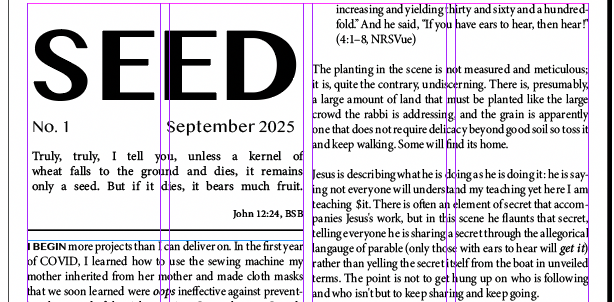
Truly, truly, I tell you, unless a kernel of wheat falls to the ground and dies, it remains only a seed. But if it dies, it bears much fruit.
John 12:24, BSB
I apologize for missing last month’s Rearview. I begin more projects than I can deliver on. In the first year of COVID, I learned how to use the sewing machine my mother inherited from her mother and made cloth masks that we soon learned were ineffective against preventing the spread of the airborne virus. I save the ones I made out of a vague impulse to preserve, a morbid idea that one day a museum will collect the efforts of those years. I pick up watercolor then acrylic paints, make a few things I find beautiful and more I find hideous and set aside the paints until another mood in another season hits. Even as a kid, I rarely learned my violin concertos to point at which they could be performed. It often felt like infinite practice. My hands have never kept up with my vision. A year or two ago, as I settled into my early 30s, a psych doctor pointed out I hadn’t sat still the entire session and asked if I’d ever discussed attention patterns with a doctor before. Well, no. No... thank you.
I’ve learned how to begin. I’m very good at beginning, and doing so particularly in solitude. I learned to use a sewing machine in a time when I saw and touched no one in hopes that the masks I made would allow connection. I’ve painted some pretty things to give to friends. I learned an instrument so well that even now when I’m out of practice, I can still feel the sounds I hear in my fingers. If a lover sees the violin case, he may ask me to play for him and I can still manage the opening lines of a concerto I’ve never performed except in moments like those. And here you are, someone with a life that is likely, maybe utterly, distinct from mine, and you’re reading these words. Scatter enough seed and some will find its soil.
The image of scattering seed is something I’ve been thinking a lot about recently. I am a Christian theologian and a gay man, so the image is evocative on a few fronts. In a couple of its places, the Christian New Testament refers to the process by which a seed produces new life as death. The passage quoted above is one. The seed must die to bear its fruit—that's how I remember the verse, but its language isn't as certain as that. The seed only has an opportunity to die into new life if it falls to the ground. It must fall or be thrown. It must be scattered, just as Jesus scatters his disciples to go and tell the good news that the Kingdom of God is at hand, healing the sick in his name, and when they are not received with welcome, to dust their sandles off and keep moving.
The famous parable from the synoptic gospels (Mark 4, Matthew 13, Luke 8) from which the Octavia Butler book gets its name, the parable of the sower, describes the risk of scattering seed. From Mark:
Again he [Jesus] began to teach beside the sea. Such a very large crowd gathered around him that he got into a boat on the sea and sat there, while the whole crowd was beside the sea on the land. He began to teach them many things in parables, and in his teaching he said to them: “Listen! A sower went out to sow. And as he sowed, some seed fell on a path, and the birds came and ate it up. Other seed fell on rocky ground, where it did not have much soil, and it sprang up quickly, since it had no depth of soil. And when the sun rose, it was scorched, and since it had no root it withered away. Other seed fell among thorns, and the thorns grew up and choked it, and it yielded no grain. Other seed fell into good soil and brought forth grain, growing up and increasing and yielding thirty and sixty and a hundredfold.” And he said, “If you have ears to hear, then hear!" (4:1–8, NRSVue)
The planting in the scene is not measured and meticulous; it is, quite the contrary, undiscerning. There is, presumably, a large amount of land that must be planted like the large crowd the rabbi is addressing, and the grain is apparently one that does not require delicacy beyond good soil so toss it and keep walking. Some will find its home.
Jesus is describing what he is doing as he is doing it: he is saying not everyone will understand my teaching yet here I am teaching it. There is often an element of secret that accompanies Jesus's work, but in this scene he flaunts that secret, telling everyone he is sharing a secret through the allegorical langauge of parable (only those with ears to hear will get it) rather than yelling the secret itself from the boat in unveiled terms. The point is not to get hung up on who is following and who isn't but to keep sharing and keep going.
To borrow a distinction from John Durham Peters's excellent book, Speaking Into the Air: A History of the Idea of Communication (1999), Jesus is teaching a model of dissemination, not dialogue. Not that the people who hear don't matter, they of course do, but that the act of sharing the gospel is not a one-on-one thing that happens in the context of a trusting relationship of friendship or something like it and instead more of a tossing into the wind, which flies in the face of the idea of evangelism I was raised hearing about and never quite practicing myself, of relationships of deep conversation and care in which one party may feel that they are always interesting to the other as a potential product rather than a person. If carelessness is the danger of spreading one's seed to the wind, of "open scatter," coercion is the danger of "coupled sharing," to use Peters's phrases.
I do believe there is the root here for a theology of sexuality, but I’ll save that for marriage later—sorry, old habit. More on this theme can be found in the second chapter of my dissertation, but the above is from the start of an idea I’m considering called SEED. It’s an occasional publication on a large, thin sheet of paper that can be folded and folded down into about a square inch. The idea came when I opened the box of my inhaler and such a packet fell out, with instructions printed on it for—I don’t know, I didn’t read it—presumably how to breathe.
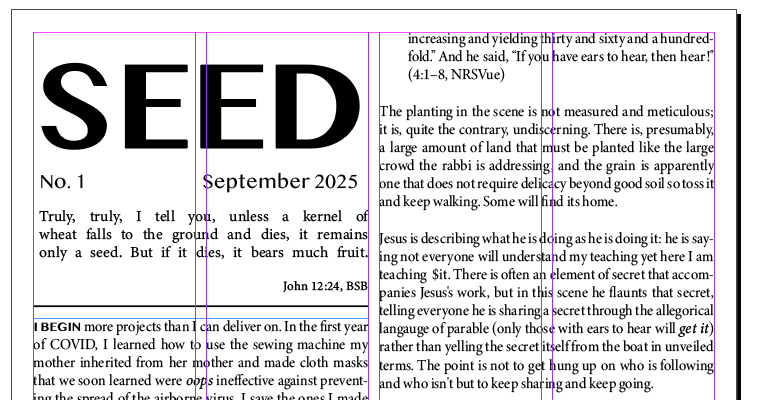
My pietist forebears hawked religious tracts and pamphlets and something about the smallness of the folded packed and the largeness of the unfolded document speaks to me. It’s not that I want to throw the Gospel or my own writings at someone, but they could be purchased in SEED packets and given to friends, placed in bowls near a cash register, and otherwise left around. Analog writing has a place in sparking curiosity and releasing minds otherwise bending toward automation, fascism, and despair, or so I hope.
I am applying for fiscal sponsorship for Homodoxy. Under fiscal sponsorship, a project (like Homodoxy) is taken under the wing of an established nonprofit, which lends the project its tax exempt status for receiving tax-deductible donations in exchange for a small percent of the donations. So, I could fundraise. It’s a flexible structure, so I could use it to publish one book at a time alongside a job, or, depending on funding, the press could become my job.
I am a step closer to being able to deliver on my dreams—the line of reprints I’ve written about here and commissioning new writing.
If you know of people who are doing work that might fit in the domain of Homodoxy, or if you yourself have queer thoughts percolating, let me know. Should funding come through, I will be publishing a very small amount—likely two books a year—so I have to be very selective. Particularly at the start of the project as Homodoxy establishes its tone. Projects in which queerness is irreducible to Christian faith and vice versa but spark creative tension. Projects in which inexplicable transcendence comes bam and you’re left with imperfect words. Projects you’d trust me to work on you with and develop into an attractive book to be sold in stores and donated to small queer libraries.
Also, consider including Homodoxy in your charitable giving. I’m not able to accept donations quite yet, but Lord willing, the time is coming soon.
Back to writing.
xo,
sam