Edmund White's Christian Brothers
the late beloved writer on Tim Dlugos and Kevin Gordon
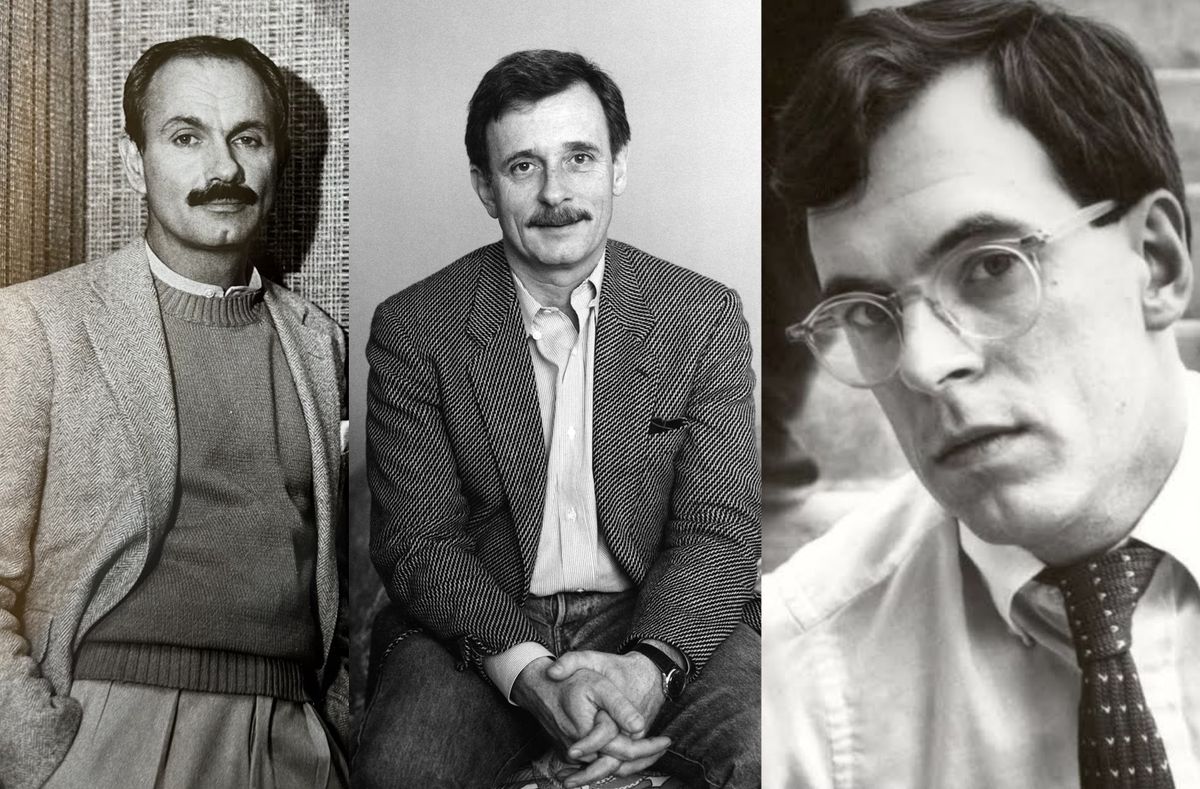
Edmund White, the eminent writer and mentor to several generations of writers, died on June 3. His novel A Boy’s Own Story (1982) was among the first handful of gay novels I read upon coming out. That is itself a common story: White and his books were part of many a gay boy’s Bildung.
As Tim Dlugos wrote in his review of the book for Christopher Street, A Boy’s Own Story “brings back the anguish, the powerlessness, the boredom, and the dreams shared not only by those with ‘different’ desires, but by all who experience the bumpy process of covering the child’s essential, isolating uniqueness with the borrowed garments of socialization.”
White knew the two primary men I’m writing about in my dissertation: Tim Dlugos and Kevin Gordon. Both were for a time involved with the De La Salle Christian Brothers, a lay Catholic religious institute whose charism is teaching the poor. Both left the institute in the 1970s, prior to meeting White. He knew them separately.
Tim, a poet and writer, and Kevin, a theologian and activist, were active at the same time and shared some circles, but they didn’t know each other from what I can find. When I interviewed White on Skype in January 2024, he spoke fondly of Tim (they were acquaintances for some years) and didn’t recall Kevin (they met only once). Both feature in his popular travelogue, States of Desire: Travels in Gay America (1980). Kevin appears under the pseudonym Sean as a local authority on the Castro. Tim is not named, but White stayed at his place in Key West while writing about the city, and his reflections on time with Tim in Key West match his description of it in the book.
White’s friends have written beautiful tributes following his death. See those by Yiyun Li and Garth Greenwell. Other friends and acquaintances should still be alive today, sharing their stories of Ed. In losing him, we lose the memories he carried with him of those who preceded him in death, including many who died of AIDS. Kevin died of AIDS in 1989, while writing his dissertation; Tim in 1990, while a seminarian. Luckily, White left some of those memories on the page, and what a gift. He was a keen observer of gay culture for half a century, and he observed both Kevin and Tim, and I’m trying to put my thumb on what that means, and what it might have meant for them.
White visited Kevin on Castro Street while researching States of Desire. Kevin says it was 1980, but it must have been earlier, given that the book was published February of that year. Kevin had lived in San Francisco since 1972. He had been a professor of religious education, an administrator for the Human Sexuality Program at the University of California San Francisco, a public lecturer on Catholic ethics, a leatherman, and a therapist. He was known enough that when White asked friends and friends of friends for interviewee recommendations for the Castro, he found Kevin.
White describes Kevin as “a San Francisco therapist who deals largely with gays. . . . a former clergyman who taught theology for several years and continues to treat quite a few disturbed priests and nuns.” Kevin hadn’t been clergy, which suggests a deacon, priest, or bishop. As a therapist to priests, the former brother had a peculiar priestly function of his own: he was confessor to the confessors. As a theologian and therapist—like several other gay theologians of the period—Kevin dealt both in sin and neurosis, in belief and fantasy.
The two spoke at Kevin’s apartment on Castro. White was impressed with the apartment, and with its curator. He writes,
The décor is in such good taste that the apartment is featured in a photo book of classic gay interiors. Chocolate brown walls, enough votive candles to supply Lourdes for a month, suede couches, hand-painted shutters, a white double bed floating above the floor on slender chromium supports, rack after rack of animal horns—this is the look we call “elegant and masculine.” Sean… is also both. He is dressed in a striped, short-sleeve polo shirt and high-waisted green pants, very full in the leg but tight around the buttocks, as though they were army fatigues tailored by YSL. He is so deeply tanned that one is surprised to hear an Irish surname; he’s the sort of person who virtually switches races in the summer.
White’s description of the apartment shows the eye for detail and style that made his connoisseurship of gay life vital at the time when gays were congealing as a people, including in no small part through writing. For all the particular details, White’s handwritten first draft of his San Francisco section says Kevin’s apartment is “so typical.” Kevin, and his apartment, fit a recognizable gay type.
And White observed correctly: if Kevin’s tan would have been surprising for an Irish person, that is because he was not Irish American but Italian American—he changed his name, first and last.
White captures Kevin’s oddness. Although “he’s quite capable of kindling to humor,” Kevin does not “match smile for smile, giggle for giggle, assent for assent, and he makes one aware how much one usually depends upon the continuing conspiracy of surface agreement in dealing with strangers.” Kevin does not mirror; he channels a vision that is his own, yet familiar. His curation of space and appearance is matched by attention to the words he uses. “After he hears a question he pauses—a very long pause—and then delivers a rapid, articulate answer—a voice-over, of course, above a disco tape.”
In White’s portrait, Kevin is a self-stylized synthesis. Elements that would otherwise be incongruous are united in his person. “Everything in Sean seemed chosen and I was impressed by the way he had composed an odd personal bouquet out of such disparate elements—a bit of Aquinas, a bit of Donna Summer, a lot of East Side chic, a fern spray of Freud, a nosegay of socialism. His own personality is so strong he lends the odd blend a sense of integrity. I picture him sniffing it thoughtfully, rearranging.” White’s picture from an afternoon together matches how lifelong friends of Kevin’s have described him: meticulously oriented to details with an appearance intended to impress upon you that here is someone to listen to. And yes, darling, expensive taste.
Their conversation ranged from the differences between local bars to the state of youth in the Castro to the benefits of being in your 30s or 40s (“‘a man in his thirties or forties, if he’s in good physical shape, does much better than someone in his teens or twenties,’” Kevin tells White, to which White adds, “In superb shape, Sean speaks with authority”) to the “pseudo-problem” of homosexuality for Christianity to psychology to the crisis of rising conservatism in the United States to fantasy and what Kevin himself had learned from sex. White quotes him: “‘There are parts of me—jealousy, violence, tenderness, a desire to be nurtured—that I would never have known about if they hadn’t come out in sexual fantasies.’”
As someone who literally dressed the part of a respectable gay theologian, Kevin was careful to whom he revealed elements of his own sexual biography. The most intimate thing I’ve learned about Kevin, I’ve learned from White. Through him, Kevin teaches that the theologian’s intimacy is an audience question.
The mix of Catholic tradition with a recognizable type of faggotry that comes across in White’s vignette of Kevin is also true of his theology. Kevin attempted a gay theology that drew what it could from Catholic tradition while critiquing its heteropatriarchal elements—a challenge—from within gay life. That his theology emerged from gay community was crucial to him as someone informed by feminist and liberationist theologies. Gay community was to him a site of divine revelation.
When Kevin returned to Union Theological Seminary to write his dissertation after some thirteen years in San Francisco, he cites White’s interview with him in the submitted introduction to his dissertation. In a paragraph that accounts for some of what he’d been up to during his long break from doctoral studies, Kevin writes, “In 1980, I was interviewed as a gay spokesperson with a sense of the pulse of gay life in Edmund White’s States of Desire: Travels in Gay America.” Beyond pride, White’s recognition of Kevin as a local authority was important for Kevin. When casting out a new question, a theologian draws in new discourses and thus considers new standards of authenticity, and the fraught category of experience is often the authenticator of theologies knowingly marked by difference. There are good reasons for that, but how does gauge experience? How does one put it on the page?
If the question is how to understand gay sex theologically in a manner that fits real gay experience, being sought out by White, the co-author of The Joy of Gay Sex (1977), is as much a credential as the dissertation Kevin did not finish before AIDS killed him.
White met Tim a few years earlier. On July 27, 1976, White wrote to David Kalstone, the critic, about the occasion. He reports that he was introduced to “a cute 25-year-old poet named Tim Dlugo or something and his still younger lover” at a dinner hosted by poet Michael Lally, one of Tim’s closest friends. (White missed the “s” in Dlugos, and nota bene: the “l” is silent.)
Michael’s dinner fell about two months after Tim moved to New York from Washington, DC, where he had participated in the Mass Transit poetry scene that Michael had established. Tim followed Michael’s own earlier move North.
That night, Tim seems to have amused White, ten years his senior. White writes,
Tim is very enthusiastic, worships Michael… and is an ex-priest. I drew the taciturn lover aside and asked him if Tim had converted him to the Church. Yes. Does he make you pray with him? Yes, the boy said, but I won’t do it. Some things must be private! (The boy was a Baptist).
Tim was not an ex-priest. In 1968, upon graduating high school, he entered the novitiate of the Christian Brothers. He entered the institute in a period of experimentation in the institute: novices were granted freedoms that allowed more intimate contact with the world. Tim followed that freedom, took up poetry, experienced “the most grace-filled moment / of my life” in bed with another boy, and left the institute in 1971. He took a “vacation” from Catholicism but remained enough of a Catholic that White felt the need to check in on his lover.
Tim’s diaries from his early months in the city portray a young gay swept up and away, befriending writers like Jane DeLynn, Eileen Myles, Cheri Fein, Brad Gooch, David Kalstone, Joe Brainard, James Schuyler, and John Ashbery. In his journal on July 27, 1976, he wrote, economically, “Met Ed White this week—wonderful man.” After that evening, White joined the cast of characters that dance in and out of Tim’s 1976 journal.
That same month, July 1976, Christopher Street published its first issue. The magazine was a glossy, still horny, New York cousin to the grittier rags of the early 70s, like San Francisco’s Gay Sunshine and Boston’s Fag Rag. It became a hub for emerging and established gay and lesbian writers. White became a regular contributor to Christopher Street and sat on its editorial advisory board, while Tim became a contributing editor. The December 1976 edition of Christopher Street featured the first installation of Tim’s column Rough Trade, which discussed the world of gay publishing. Tim covered, for example, the memoirs of David Kopay (an out American football player); the artful postcard collages of John Ashbery, Joe Brainard, and others; and The Joy of Gay Sex, cowritten by White and his therapist Dr. Charles Silverstein, alongside The Joy of Lesbian Sex and their straight corollary, The Joy of Sex.
Although Tim is remembered primarily for his poetry, he was also an active reviewer during a period when gay writing proliferated. He published reviews, essays, and interviews in many outlets, but he was a regular in Christopher Street, a flagship publication in the emerging world of gay letters.
White and Tim were not close friends on White's account, but they remained in each other’s orbits. White visited Tim’s place in Key West in 1978, as he later recounted in The Guardian, and he stayed again for a couple weeks the following January, when he had “one of my few acid trips.” In my interview with White, he said he didn’t remember if Tim took the acid trip with him. He didn’t see Tim write at all in their time together at Key West. And he didn’t think that the two of them had ever been lovers. I hadn’t asked but was happy he answered. He paused, then asked, “Was he a bottom?” Ed giggled, arpeggiating upward from a sharp F#.
White described Tim as someone with whom one would instantly feel close without him disclosing much. Tim had a wry humor, “a way of holding his mouth so that you always saw his teeth, and he’d oftentimes be looking off to the right or the left.” Despite the early dinner encounter, White said, “you didn’t hear much God talk from him. But maybe that’s because we were New York atheists.”
In 1981, Dlugos wrote and dedicated a poem to White. The poem, “The Lions of St. Mark’s,” illustrates a quality that his friend the poet Douglas Crase identified in New York School poets of Tim’s generation: “a faith in chance and daily experience, a faith that whatever came in through the open window would be redemptive and nourishing, or else no worse than a disappointment, which would be nourishing as well.” Like the poems that would mark his later years, it features long stanzas in which a moment of light pokes through then glimmers like an ember. Tim writes,
In the little Polish
parish down the street, it’s time
to light a candle, partly from devotion
but mostly for the image it provokes:
nostalgic you as supplicant, mantilla bobbing,
kneeling on the slab before a saint whose up-
turned eyes are hidden by a cloud of smoke.
He has been expunged from the calendar
like a wasted day, though we like to think
that no day’s truly wasted.
White mistook both men for former clergy. It’s an understandable and common mistake. Well, it is a mistake and it isn’t. White’s slip named something true about the roles Kevin and Tim took on beyond the Roman Catholic church: Kevin, as a theologian of gay life and confessor to priests and nuns, and Tim, who studied to become an (openly gay) Episcopal priest who, at the end of his life, wrote a paper about ministry not to the dying but of the dying. They were clergy for the gay world.
Queers love canonizing saints. Wherever gays populate feast day calendars with their models of taste, filth, humor, and style, Edmund White will be there. His day will not be expunged.
It is a testament to the loving labor of Tim’s friend David Trinidad, who edited two posthumous collections of Tim’s poetry—including the definitive collection, A Fast Life (2011)—that Tim’s poetry has found a substantial readership in the last decade or so. There are more sides of Tim, and I am editing Tim’s selected prose for publication. To honor Ed and Tim, I am reprinting Tim’s wonderful review of A Boy’s Own Story as a Rearsource. Find it here.
Douglas Crase’s superb poems and essays deserve more than passing mention; they deserve consideration of their own. But for now, a note of thanks to him for the wonderful afternoon in the city. And the books.
I’ve written on Kevin before for The Rearview, here.
I curated a list of White’s writing for first time White readers for The Yale Review’s new Substack, Back Matter, here.
Check out last month’s guest essay by Lacey Jones here.
Happy pride/rage/pleasure month.
<3,
sam