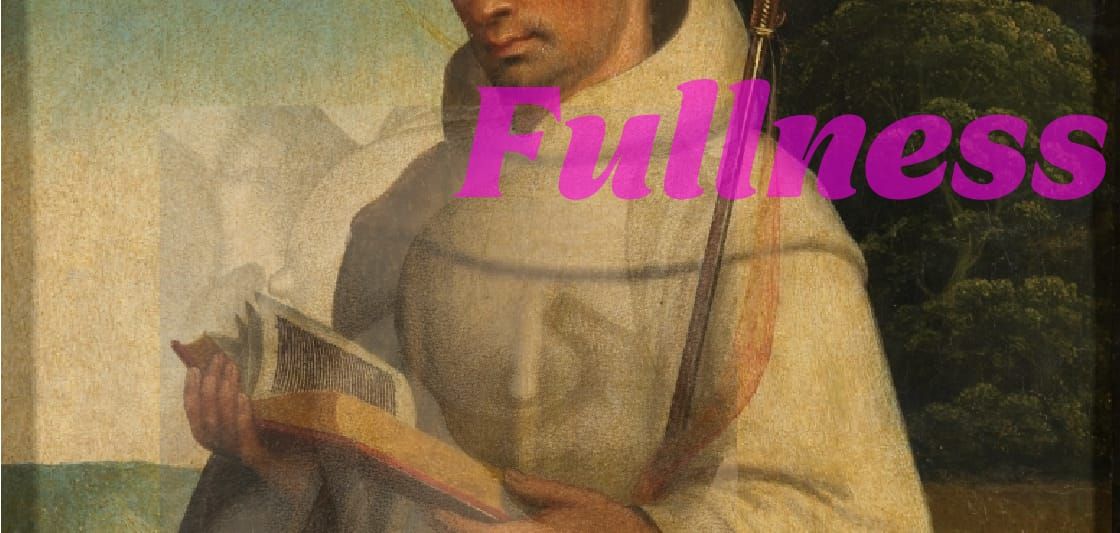
Fullness
reading the breasts of the bridegroom

Originally published by The Audacity on May 14, 2026, as part of Roxane Gay’s Emerging Writer Series.
To love something is to. . . wish that it be what it is in the fullest sense possible.
Eat whatever is sold in the meat market without raising any question on the ground of conscience, for “the earth and its fullness are the Lord’s.”
Around age 12, I discovered gay men’s underwear websites. Some websites displayed their wares against a white square of nothing—not on a man but lifeless, the pouch where a dick would go looking sad, like a deflated balloon. Other stores dropped a generic man into their briefs, silhouetted against the white square. These were gym bodies framed from thigh to jaw, the same poses for each garment: jockstrap in white (front; back), jockstrap in black (front; back), jockstrap in red (front; back), a grid of these. When the garment fit the model well, his junk looked plump, like a bunch of grapes; when the underwear had been paired without attention to fit, a shrink-wrapped plantain.
More expensive websites understood that the garment must sell the model for the model to sell the garment. They would show their men, face and all, in an interesting setting—an Australian beach, for example, or a ranch, maybe an Australian ranch—with angles that found the fullness each brief and jockstrap proffered. It’s an art where portraiture meets still life: every shape is a fruit ripe for the picking, swollen and contained.
But harvesting was not for me. I couldn’t tell what I was looking at, if it was beautiful or demonic, and I couldn’t tell what my looking meant. I told myself underwear was ok to look at because it was practical, often disembodied, kind of funny, even, like a banana peel. But I could feel my desire, busting out of my growing, husky frame, and I tried to shove it back in.
I don’t remember which came first, the underwear websites or the little video clips. In the mid-2000s, YouTube became the undisputed queen of bits of this and that. Before YouTube, there were a host of sites where you could watch funny, short videos, like addictingclips.com. Interspersed between thumbnails for various silly animations and cartoons were wondrous things, like an advertisement for a sex chair with two seats that could be set in several positions so that when the sex chair was activated the genitals of two naked models would crash into each other, then separate, back and forth, bang bang.
The sex chair was fine for me to watch because it was clearly ridiculous. But I moved on to clips that were harder to justify. One woman filmed herself bathing in negligees. The tub was outside, and she would bathe behind a veil that would gradually move aside as the camera approached. Another woman posted videos in which she flexed her pectoral muscles, making her globous boobs tense and shrug. This blew my mind. At least they were women, I told myself. Finally, the site brought me a full-chested man doing something similar. Oiling his pecs, playing with his nipples, even lactating. I was transfixed. Men don’t make milk, as far as I understood. How could a body I thought was empty be so full?
As an infant, I nursed so hard that I drew blood. As a child, I sat on my bedroom floor trying to lick my own nipple. In middle school, I developed a miniscule lump under the surface of my right nipple—a small bead of tender flesh. It hurt to touch. The doctor said it was nothing serious, a thing that boys occasionally experience during puberty. It could be an omen of breasts to come: gynecomastia (as the NHS clarifies, “sometimes referred to as ‘man boobs’”). But probably not. I pressed on it despite the pain, wanting it to do something or go away, or to make sure it was still there, like a good luck charm. I remember a single pearlescent drop, watery, white, at the tip of my nipple. I tasted it.
My chest wasn’t the only part of my body I regularly examined. I measured my dick throughout puberty, penciling its progress on a page of my journal like height marks on a doorframe as it grew. Anything to help me notice and feel my body. I became creative. When I’d outgrow a pair of pants, I would cut them into a bespoke little creation of my own. Wearing the remnants, I could briefly see my body in full, how my growing pieces fit together. Then I’d cut it to shreds, throw it in the trash, and take out the trash, hoping it was garbage day.
I was horrified by what my body required. I journaled cryptically about how desperately I needed God to change me. For every perverse action, there was a pious reneging; for every sin, a confession. What was the sum? Somehow, not zero. I was both empty and full.
My mom spent her working life as a pastor, and a savvy one. Once, when the teenagers in catechism class weren’t responding to the Bible, she led them through the Song of Songs—a strange, erotic book about a bride and groom enthralled with each other’s bodies. This reading experience must have been horribly awkward for everyone, but, she said, the youth paid attention. It’s a good strategy: use the part that shouldn’t fit as a window into the whole and recast the whole thing in its light.
In high school, I thought I might become a minister like my mother. I felt that calling. The denomination I was raised in was a pietist offshoot of the state church of Sweden in the 1880s. Pietists believe that the Bible should be in the hands of the people, not only in the hands of ministers and academic theologians, of whom pietists are sometimes wary. The denomination today believes that gays should not be ordained unless they are celibate.
Early on in college, as my sexuality emerged and became a problem for my faith, I turned to books about homosexuality and the Bible. I read book after book of dull heterosexist interpretations of Scripture and repetitive affirmations of gay marriage until I achieved a state of exhaustion. I did not toss out the Bible, but I began to hold its interpreters at arm’s length, because my body knew, on some level, that they were not relevant authorities. My body knew, simply, that I was neither a celibate nor a half looking for his other half. My own reading of scripture would have to come.
I became an Episcopalian midway through college and suddenly ordination was a possibility again. I entered divinity school to consider life as a priest or as a professor. The courses I took in theology, biblical studies, and literature introduced me to new and ancient ways of reading texts, like the Song of Songs.
What if the entirety of scripture is the tale of two lovers? What if we read the Song that way? This is, actually, a painfully orthodox understanding of God and God’s people. The bride is the people of Israel; the bridegroom is God. For Christians, the bride becomes the church; the bridegroom, Christ. Reading the Song as a parable of God and God’s people is both an imaginative way of reading and, in some renditions, a desexualizing one: the depths of erotic description are not really about sexual pleasure between two humans but the joy of union with God.
Medieval Christian monks had several modes of reading the Hebrew Bible to choose from that allowed them to luxuriate in all of the Song’s fruity language. These included literal or historical readings and a variety of spiritual readings: reading a passage as an allegory for the coming of Christ, as an intimate lesson for the reading believer, and as a window into the life of the world to come. Readers developed a sense for which to prioritize with which passage.
The monks delighted in spiritual readings of the Song. The Song begins with the bride: “Let him kiss me with the kisses of the mouth!” In the hands of Alan of Lille, a 12th-century French Cistercian, the kiss becomes the meeting of divine nature (the mouth of the bridegroom) and human nature (the mouth of the bride) in the incarnation of Christ. “The Bride’s longing for the Bridegroom’s kiss becomes an image for the Virgin’s longing for the conception of the Word within her,” writes Denys Turner, in a book about the Song. The kiss promises a fullness to come, life growing deep within.
In Turner’s medieval theology class, I encountered St. Bernard of Clairvaux, a Cistercian abbot from the 12th century. Bernard, in a feat of devotion, preached 86 sermons on the Song of Songs to his brothers, each sermon taking as its text a fragment of the poem, an image, a theme. As the bride and bridegroom celebrate each other’s bodies through proliferating metaphors, Bernard joins in. His first several sermons focus on “the kiss of the Lord’s feet, hands, and mouth.” In the fourth sermon, he acknowledges that it might sound odd to think of God’s body in such detail, since, because “God is spirit, his simple substance cannot be considered to have bodily members.” However, he says, by God’s mouth, God teaches us; with God’s hand, God provides for us; and for God’s feet, the earth is made a footstool. The parts “represent certain modes of our encounter with him.”
Turner had devoted his life to the material, and he lectured without notes. The words he was looking at were not on the page but, apparently, somewhere off in the distance: the written had become rote. Throughout the semester, the old Englishman stood by the same window, gazing outside at a particular spot with such predictability that one day, a student who had been paying attention planted themself in the spot outside the window with a sign that said something like, “Hello, Professor Turner.” Some of us in the class didn’t know that a prank was underway; we just heard our professor say, “Oh, fuck off.” Suddenly, he was back with us.
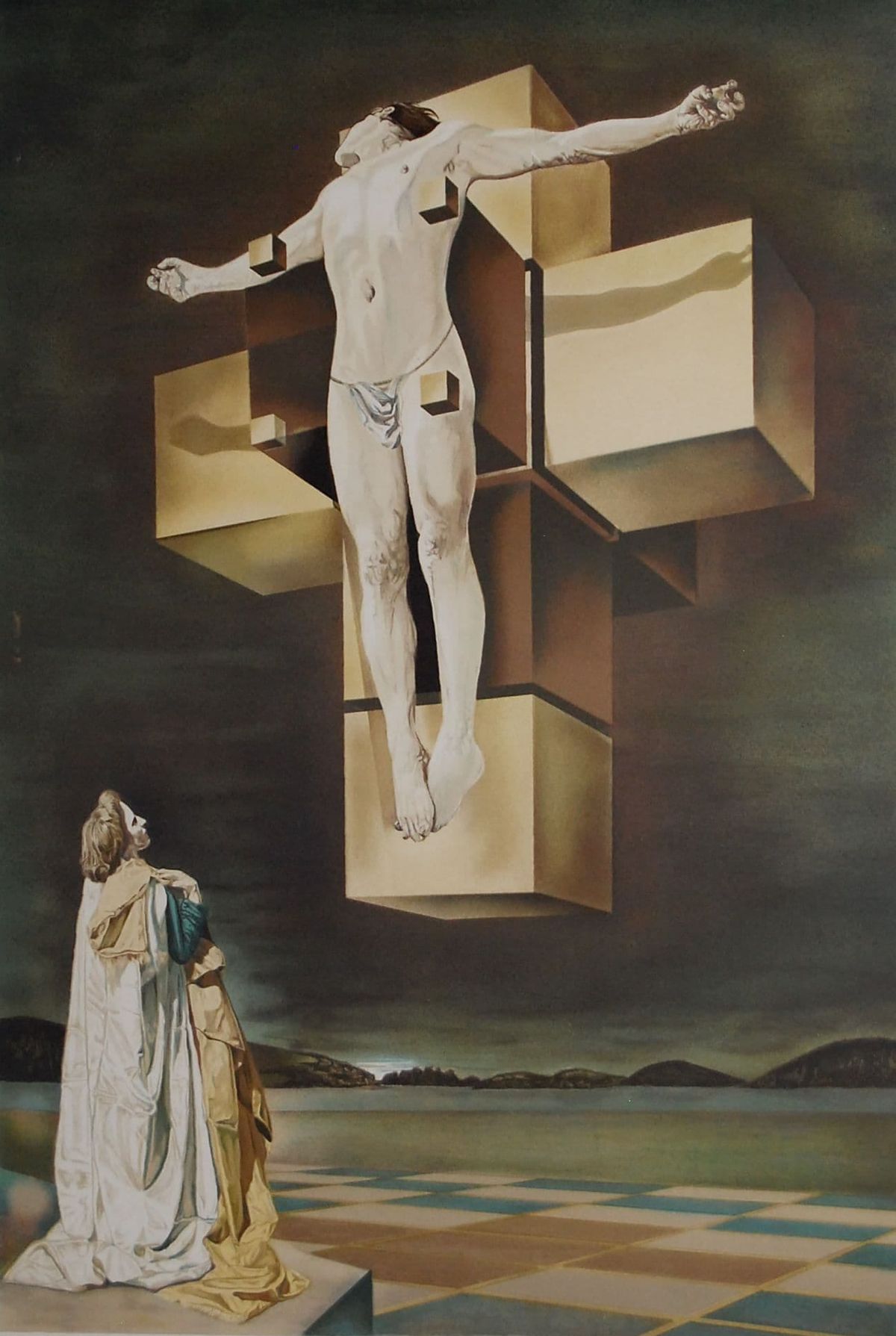
Nine sermons in, Bernard turns to Song of Songs 1:2: “For your breasts are better than wine, smelling sweet of the best ointments.” The preacher says, “The author does not say who spoke these words, so we are free to assign them to the person whom we think they best suit.” He sees good reasons to read them both as the breasts of the bride (the believer) and as the breasts of the bridegroom (the Lord). What do we make of the Lord’s breasts? “These two breasts,” Bernard postulates, “are two proofs of his native kindness: his patience in awaiting the sinner and his welcoming mercy for the penitent.” His patience and mercy are abundant, overflowing from the Lord’s heart. Or, drawing on a psalm of David, Bernard says we might describe his breasts as “slow to anger” and “most loving.”
It isn’t difficult to see why some queer theologians and biblical scholars love monastic readings. These celibate men understood themselves as Christ’s lovers, even imagining themselves to be pregnant with the Word. The strangeness of their readings provokes some readers to speculate about the monks themselves: these were queer communities of gay lovers. If we can say these monks are gay, then the church should let us be gay, too, the logic goes. But I’m not here for permission. I’m here for delight.
I’ve been thinking, if this essay ever gets picked up, that I will tattoo “slow to anger” and “most loving” on my tits. Or is that too on the nose? Another English expert of eros, drag queen Bimini Bon-Boulash, says, “The nipples are the eyes of the face.”
Having considered the bridegroom’s breasts, Bernard turns to the breasts of the bride, the believer. In response to the Lord’s holy kiss, the believer undergoes a bodily change: “so great is the potency of that holy kiss, that no sooner has the bride received it than she conceives and her breasts grow rounded with the fruitfulness of conception, bearing witness, as it were, with this milky abundance.” Lest this sound unrelatable to his brothers, Bernard continues,
Men with an urge to frequent prayer will have experience of what I say. Often enough when we approach the altar to pray our hearts are dry and lukewarm. But if we persevere, there comes an unexpected infusion of grace, our breast expands as it were, and our interior is filled with an overflowing love; and if somebody should press upon it then, this milk of sweet fecundity would gush forth in streaming richness.
You know you’ve been kissed by the Lord when you are “conscious of having conceived.” And with conception comes milk: food for the lover. Purposeful intermingling of genders might invite strictly metaphorical readings, but to me, Bernard’s reading draws together swelling breast and overflowing spirit beyond separation. Reading the Song has changed how he sees his own body. No need to speculate about his sexuality; the celibate’s readings are wet enough. He hedges his metaphors with “as it were,” but Bernard is the bride. His breasts are filling and gushing. Why should the spiritual not press into the literal? When a man’s chest fills with spiritual milk, who does he feed?
Bernard, bless him, would be horrified by this essay. He is careful to say that this is a spiritual milk, a spiritual swelling—not carnal. This milk exceeds the wine of worldly knowledge. For after all, “the grape, once pressed, can never again exude its liquid, it is condemned to endless dryness. So too the flesh, caught in the winepress of death, is completely drained of its co-natural pleasures, never again to revive to the stirring of sensual passions.” But the breasts of the believer kissed by God are endlessly deep: “the numbers who drink of them, however great, cannot exhaust their content; their flow is never suspended, for they draw unceasingly from the inward fountains of charity.” Within the breasts of the bride, eternity wells up.
Bernard’s reading isn’t so different from the attention that one gives to the body of a lover. The reading is both a kiss and what the kiss creates, a relation that blossoms the body and brings to fruition the wholeness of what is there.
I would like to see these things as reconcilable: Bernard’s allegorical reading of the body of the believer and the body of the believer itself. Why should I be a raisin? Surely, Bernard, you felt a swelling, spirit overflowing into flesh. You felt it in your own chest, held your breast, heavy with the rich milk of Christ’s love, and asked, what is happening to me? This was the gospel, at least for a moment.
God touches the body, and the body changes. What then? Bernard, at least, reads the changed body. Does the body change only so we can read it and not touch it? Put more intimately, when my body overflows with love, is that change only private? No, the overflow may do noticeable things to the body—I breathe more deeply; I cry; I whimper; and gradually, over days and years, I hold my body differently. The changes invite new readings, relations materialized in the touch of a lover. The body, read, blossoms in ecstasy, as the satisfaction of its reader overflows.
How much distance exists between the reading of the body and the body that is read? Forgive me. I am bonking up against the limits of what I know how to say. I’m reaching exhaustion.
How close can I get to you?
At coffee hour one day at the divinity school, a seminarian told me his favorite underwear brand, inspiring me to order my own online. I began taking pictures of myself in the underwear and encountered myself for the first time like the men on the underwear websites: in cropped pixelation. The thrill of window shopping turned into a sense of awkward exposure when it was my own self in the pouch and straps. The feeling left gradually as I learned to see myself through the camera.
I discovered my first go-to pose. With a light source above and in front of me but behind the camera, I take a selfie from below my chest, camera tilting upward. Shadows fall. My tits look big.
I began to think that someone might want to look at me, and looking at me, might want to feel me. During long periods of reading and writing, driven by those thoughts, I’d do push-ups and sit ups with some inkling that my body would grow along with my mind. The classroom education and the pictures weren’t enough. They were prelude to touch.
Something real was growing in me, and I needed to feel it in my sore muscles, especially my chest. But feeling it myself wasn’t enough. I needed others to touch my body, to read me with hand and mouth and to let me read them. I doubt my first lovers knew it at the time, but their touch taught me to love what I hated. My hips, thighs, bottom, chest—the things that made me husky as a kid could nourish others.
I wonder how much sexual desire is about the interplay between part and whole. Doesn’t a part imply a whole? Giving your hand, your hole, your lips, your ass, you give yourself, or at least a version of it, even if the one part is all the other sees or feels. It’s the gloria of the glory hole: I am what you encounter through the veil, and yet I am more. In a similar way, desire exceeds the language we give it. In the moment when dirty talk becomes more than a script and language is stripped to its most stupid and true, to say, “I love that hole” is to say, in some way, “I love you.” But some holes just want to be holes. And they say that: “I’m just a hole.” Love isn’t on their mind; they want all thought to cease. Then, the part doesn’t suggest the whole but, for the hole, mercifully becomes it.
Desire is synecdochic; each body part becomes a mode of encounter. The writer of Song of Songs didn’t wander toward the bridegroom’s hole, or the bride’s—nor did Bernard, at least in his sermons. But Bernard called the bridegroom’s breasts mercy and patience. The bridegroom’s breasts are expressions of generosity towards sinners. Something unanticipated, undeserved, even unnatural, yet utterly needed. This makes sense to me, a lover of men’s tiddies, whose fullness doesn’t come from liquid milk.
It’s something about the shape of a man’s pec. The heaviness, the downward pull. The fullness of muscle and fat. The way a nipple clings to the body, almost dripping off. How does it do that?
I can’t help but feel it is providential. Like Moses striking the desert rock and God causing water to gush forth. A lover caresses my chest and God fills it with milky abundance. When read with erotic attention, my body aches with provision. To each created thing, its own fullness is given. And like most fruit in the garden, my fullness is to be shared.
It was evening, and I was writing. A notification popped up saying that I had matched with someone on Scruff. Then an alert from Grindr: the same guy saying “hey.” He was taller than what I often go for but still shorter than me. He was solid, hairy. I told him I had to work that night but then we swapped nudes. His ass shot was taken in a mirror, with his body lit dimly from above by white Christmas lights. In it, his back is broad, absorbing most of the light, and his ass cheeks hang below like two moons waxing gibbous: round and partly shadowed. I drove over.
He asked if we could hang out some first, and I said of course. We sat on his couch, shared our names, and acclimated to each other in quiet conversation. Michael was cute, kind of shy, 22 to my 30. He kept looking at my chest, and when we began to kiss, he reached for my pecs, gently grabbing them. We hadn’t established much before meeting—I wasn’t sure what about me he was interested in. He looked down at my chest with admiration, cupping and jiggling my tits. I asked if he wanted to suck them. He said, yeah. He framed my right pec with his hands and sucked gently. He began to knead my chest almost unconsciously, slowly, like puppies do to their mother or cats to a pillow. My tits had been sucked before, but this felt new. He was feeding. We moved into the bedroom.
My body was larger than it had ever been. Friends who hadn’t seen me in a while suggest that I am taller, and I’d blown through all my pants. I had been eating more, working out more regularly, and my limbs had become more substantial. I am proud of the fullness of my pecs, grateful to them for drawing lovers who want to be held and cared for. My thighs, my chest, my arms, even my belly, the part of me I most desire to lose now—Michael held them all, feeling my weight shift in his hands. The last hour or so we spent together, I sprawled out on his bed not unlike a buffet. We kissed, but mainly, he held parts of me while sucking my nipples in loving attachment.
When he nursed, I felt like a daddy. I told him that. He asked if I wanted to be called that. I told him, I don’t care—you are a good boy. That made him happy. Sometime later he said, you’re young, but you do feel like a daddy. I laughed and said again, good boy.
Funny how as our bodies swelled and opened, our language materialized much smaller, like marbles, or stones we tossed together across water, daddy and boy, bodies and time pooling like a lake. I hugged him close, cuddled, both of us, I think, surprised by the night. I drove home, walked the dog, and went to bed. My breasts were sore, and it was morning.
 Aurora Mattia