Spoiler, That’s All of Us
Bobuq Sayed in conversation with Denis Ferhatović


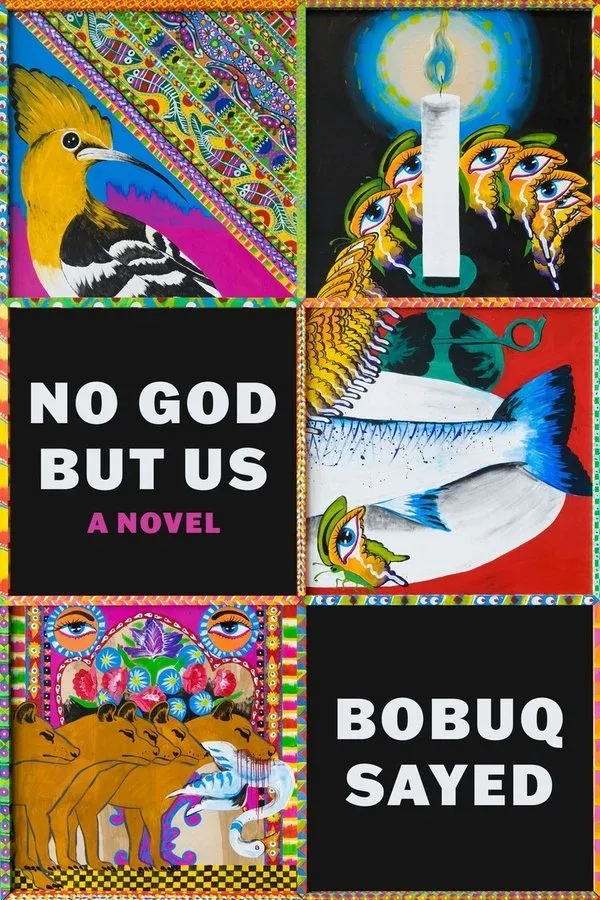
I found No God but Us at Possible Futures (a statement that makes me pause as I write it). Possible Futures is a wonderful independent bookstore in New Haven, and No God but Us is the debut novel of Bobuq Sayed. The book’s title and cover art by Iman Raad grabbed my attention, and its first sentence tucked my attention into its pocket and ran away with it: “The drag queen with my money was missing in action.” I bought it, read it, and lent it to a friend, who went to see Sayed read in the city and got my copy signed.
No God but Us toggles between the perspectives of Delbar and Mansur as they move through the world as Afghan men in diaspora, building new friendships and relationships as they leave others behind. They meet in Istanbul in 2015, during the Syrian refugee crisis and coup. Delbar has left the United States after being outed to his family. He takes refuge with his aunt, herself an outsider, and her daughters. By the time Delbar meets him, Mansur has found a life in the city. The narrative cuts follow him from Iran to Istanbul. In leaving Iran, Mansur leaves his family and the boy he becomes instantly infatuated with while cruising (in both senses of the word) with disreputable, “carnal” men. Delbar and Mansur meet in the midst of rising authoritarianism and Mansur’s open marriage with Leif, a trans German man working at a nonprofit in Istanbul.
No God but Us can be read in many ways, toward many ends: a story about the complicated relationships between queer people, a migration novel, a story of diasporic life in the wake of US imperialism in Afghanistan, and a tale with two queer men and many of the features you'd expect in a queer novel (drag, cruising, divas, fated love, a freighted threesome, a Pride parade, police violence, sex that is also prayer). But as Sayed themself says below, the novel resists the easy stories Western audiences like to hear about migrants and queer people.
Reading No God but Us, I was taken with Sayed’s wonderful details and fabulous characters as much as by questions about what the novel is or what it gives us. The friend I lent it to, Denis Ferhatović, is a member of my own queer family in New Haven. I knew he also would be taken with the book’s details and characters and, as a linguist, more familiar with the languages and cultures the book engages, so I asked him to interview Sayed for The Rearview. Thank you, Denis and Bobuq.
Enjoy,
Samuel Ernest, PhD
Editor of The Rearview
Denis Ferhatović: Hello, Bobuq. I enjoyed your novel No God but Us. Congratulations! My first question has to do with that perennial theme of food in migrant writing.
Mansur orders a large portion of “qābeli pilau” when he arrives in Istanbul. Delbar meets Mansur in the kitchen where he works for Leif’s organization PeaceMeals (a brilliantly satirical name). Poppy takes Mansur to have good Eritrean food (tibs, zigni) when he visits her in Denmark. Leif’s new partner, Kemal raves to Mansur about a pretentious fusion restaurant: “The reindeer tartare is unbelievable.” What is the place of food in the book?
Bobuq Sayed: The role of food in the novel is variegated, and it was my intention to center the preparation and consumption of food to access the personalities, upbringing, and class of different characters. Sharing food can be an act of kindness and it can also create or materialize a power dynamic. And yet, as with my experience, often it is those with the fewest means who are the most hospitable with whatever they have to give. Similarly, for people who struggle with conveying vulnerability in language, there is food, dressed up in utility and sustenance, but always loaded with this subtext of affection: “I don’t want you to suffer, let me eliminate your hunger, let me play a role in your survival.”
In those examples you shared, and others scattered across the book, we see people who eat to publicly showcase their sophisticated palette, and who select dishes for loved ones to broker access to a culture or homeland they no longer have access to. Food functions to keep introverts out of the spotlight and, simultaneously, it brings people together.
DF: Delbar at one point ponders the pressures from non-Muslims and other Muslims to position oneself in relation to religion. But your title also functions as a bold reworking of the shahada. I resisted being carried away with finding a Sufi allegory, especially in the parts narrated by Mansur, who shares his name with Mansur al-Hallaj who proclaimed “I am the Truth!” and was killed for it. Was al-Hallaj on your mind when writing? Can queerness be a kind of heretical reclaiming of religion, or do different characters hold different opinions?
BS: Cool to hear you make the reference to Mansur al-Hallaj! Honestly, my primary Mansur touchpoint was this hot Afghan guy I worked with in high school, but I see the martyrdom corollaries. When I was naming him, the historical figure wasn’t at the forefront of my mind, but this is the thing with language, as writers, you don’t get to decide which histories your net captures. You take it all. Maybe that guy I worked with was named after the figure. Who knows.
The title’s riff on the Shahada was more intentionally part of my thinking, though. So often queers are tacitly expected to shy away from religiosity and sort of accept the stigma projected onto us as our burden to bear, and I’m like, fuck that. That’s not our shame, that’s yours. With Islam in particular, there are all these phenotypical registers that mean that my religious identification isn’t really a decision I get to make. It’s made for me, by people who read my name on job applications, and by the police. They see me as Muslim. In that way, I’ve sort of come to understand my religion as a proto ethnicity. I can reconcile with it; I can never release it.
DF: I was struck by the presence of not only Persian in its various varieties (Iranian, Afghan) in the novel. When Mansur narrates, we even get transliteration with length marks for long and short vowels: for example, in the nickname his mother gives him that recurs in the narrative, “Pàyghāmbarakam,” “my little prophet.” Also, as much of the story takes place in Istanbul, Turkish, a language historically proximate to Persian, figures in.
The philologist in me was delighted at miniature lessons scattered throughout, such as: “Mansur had tagged the possessive diminutive onto the end of my [Delbar’s] name. Where an English speaker might call someone my love or my brother, the equivalent term in Farsi and Turkish abridged the two words into one. To show affection for another involved a breathless unification.” How did you weave in those two languages, and others, while writing the book in English?
BS: I appreciate you for noticing that! Part of my thinking there was to sort of subvert this hegemonic idea that queer people must go from East to West to access freedom and queerness. Like, sure, there’s a population of people for whom that may be the case, however, that expectation reproduces a lot of harmful stereotypes and, particularly with my part of the world, it erases whole swathes of queer and trans communities that exist throughout SWANA [Southwest Asia and North Africa]. It was important to me that I represent an American character like Delbar who is repressed by his American upbringing and actually finds this incredible opportunity in Istanbul to spread his wings for the first time and engage with queerness not despite, but because, of his travel to the East.
Language serves a similar function. We see Mansur sort of perplexed by Delbar’s immense frustration with the gendered limitations of English and the culture in which he was raised. From Mansur’s perspective, he’s grown up with a gender-neutral language like Farsi, and even Turkish allows you to refer to a lover’s pronoun, for instance, without ever gendering them. It’s these little ways that I wanted to demonstrate the pitfalls of our racial and religious sense of the world.
DF: No God but Us does not lack in morally complex queer characters from across the spectrum of gender and sexuality. Anahita, the Iranian trans female refugee, sex worker, and a sort of fairy drag godmother for Delbar—and his sharpest critic—is my favorite. Two other instances that have stayed with me are the Kurdish bisexual professor in Istanbul who presents the evidence of homoeroticism in the Islamicate literary tradition to the unimpressed Delbar, Viyan bey, and the German trans masculine partner of Mansur who continuously champions the human rights industrial complex, Leif.
How do you craft characters with such an unflinching awareness of their flaws and yet an understanding for their specific circumstances? What is the appeal of “bad queers”?
BS: I love morally complex queer people because, spoiler, that’s all of us! Only if we’re writing for a straight audience are writers interested in saving face because only in that context do we feel the political pressure towards respectability. Between ourselves, and especially when we’re truly comfortable with one another, that’s when we’re safe enough to show the best and the worst. That’s the book I wanted to write. I had to abandon any fear that my characters would be instrumentalized for imperialist or homophobic ends. You can’t make [good] art out of fear.
DF: The Iranian pop diva Googoosh’s song “Behesht” figures prominently in the book, appearing at the beginning and at the very end, following Mansur from Iran to Germany. There is an extensive literary intertextual network in No God but Us, where the main characters read such authors as Mikhail Bulgakov, Forugh Farrokhzad, Latife Tekin, and others. But tell me more about the book’s popular culture references.
BS: One thing that’s true about gay people all over the world: we love our divas. In the Iranian and Afghan context, that is no less true. In one of the first chapters, we encounter this car full of men cruising the streets of Tehran looking for sex and, at one point, they hear the lyrics of Googoosh. It’s this weird moment where, for them, they’re loving on this fabulous titan of Persian language and culture, who is certainly a minor deity among queer people too, but it’s also wrapped up in a kind of national identity, and so that makes it safer. I’m obsessed with all these acts of subterfuge and camouflage that queer people adopt that seem sort of incoherent but are also extremely fab.
DF: My next question contains serious spoilers, so readers may want to skip to the next question!
No God but Us thankfully does not kill off any of its major characters. At the same time, it ends in a somber place, especially for Mansur, who is caught in a chemsex inferno, or maybe limbo, in Berlin. We hear about what happened to Delbar through Mansur who gets his information online. He seems to have accepted his nonbinary identity, continued exploring drag, and found a partner. Yet the novel does not let us enjoy a happy ending on his behalf. Any indication of a hopeful future seems to reside with young female characters, Delbar’s cousins Darya and Nafas, and Leif and Mansur’s (maybe also Delbar’s?) daughter Ghazala. Do we know what happens to them? Is your future work going to focus even more on women and femmes?
BS: We don’t know what happens to them and that is the unfortunate nature of migration. I definitely intend to center women more again in the future. In a strange way, I’ve bristled at so much of the description of the book zeroing in on the ‘two queer Afghan men’ thing because, in my mind, it has always been an ensemble novel. One of my friends, the poet Zaina Alsous, aptly noted at the launch event in Miami, Florida, that one could even read the book as directly preoccupied with the consequences of women’s decisions. As in, the book’s events can largely be considered in relation to the autonomy of the women in the orbit of those two queer men. I like that. It’s a nice subversion of much of political realism where women are not in control of important things.
DF: Finally, the cover of the US edition of your novel is absolutely stunning. It consists of parts of the artwork Days of Bliss and Woe by the Iranian-American artist Iman Raad, now held at the Queensland Art Gallery in Australia. What is the story of the cover? How did you find it?
BS: I had reached out to my friend, the Miami-based curator Donna Honarpisheh, who’d recently put on an exhibit in DC of contemporary artists who practice in the tradition of Persian miniatures. I asked for her recommendation of a visual artist I might consider for the cover of my book. Then, as it goes, I neglected to read her reply for months. In that time, my publisher, Harper Books, provided me with a set of five cover options. It was obvious to my agent, my editor, and I (a rare full trifecta) that the fifth and final cover was the one. That option was drawn from the painting by Iman Raad and, as it happens, Raad was also the same artist that Honarpisheh recommended to me in her reply. That cosmic symmetry was how I knew for sure.
DF: Thank you for the interview, Bobuq. I heartily recommend No God but Us to everybody and am looking forward to reading more from you.
Bobuq Sayed is an Afghan diaspora cultural worker. Their debut novel, No God but Us, was published with HarperCollins in May 2026.
Denis Ferhatović is an associate professor of English at Connecticut College. He has published translations from Bosnian/Croatian/Montenegrin/Serbian (BCMS), Crimean Tatar, Judeo-Spanish (Ladino), Karaim, Kosovo Gorani, Old English, Ottoman Turkish, and Pomak in The Riddle Ages, Turkoslavia, The Trinity Journal of Literary Translation, DoubleSpeak, Ellipse Magazine, The Los Angeles Review, Ancient Exchanges, MAYDAY, The Third Wheel, and TERN. His reviews of translations have appeared in Asymptote, Exchanges, Reading in Translation, and Hopscotch Translation. You can find his poetry in BCMS on Strane (Mostar) and in Polja (Novi Sad), and, in Slovene translation from BCMS, in Literatura (Ljubljana). Ferhatović is a member of Homodoxy’s Editorial Advisory Cloud.