He Writes, You Writhe
an interview with Josh Tvrdy
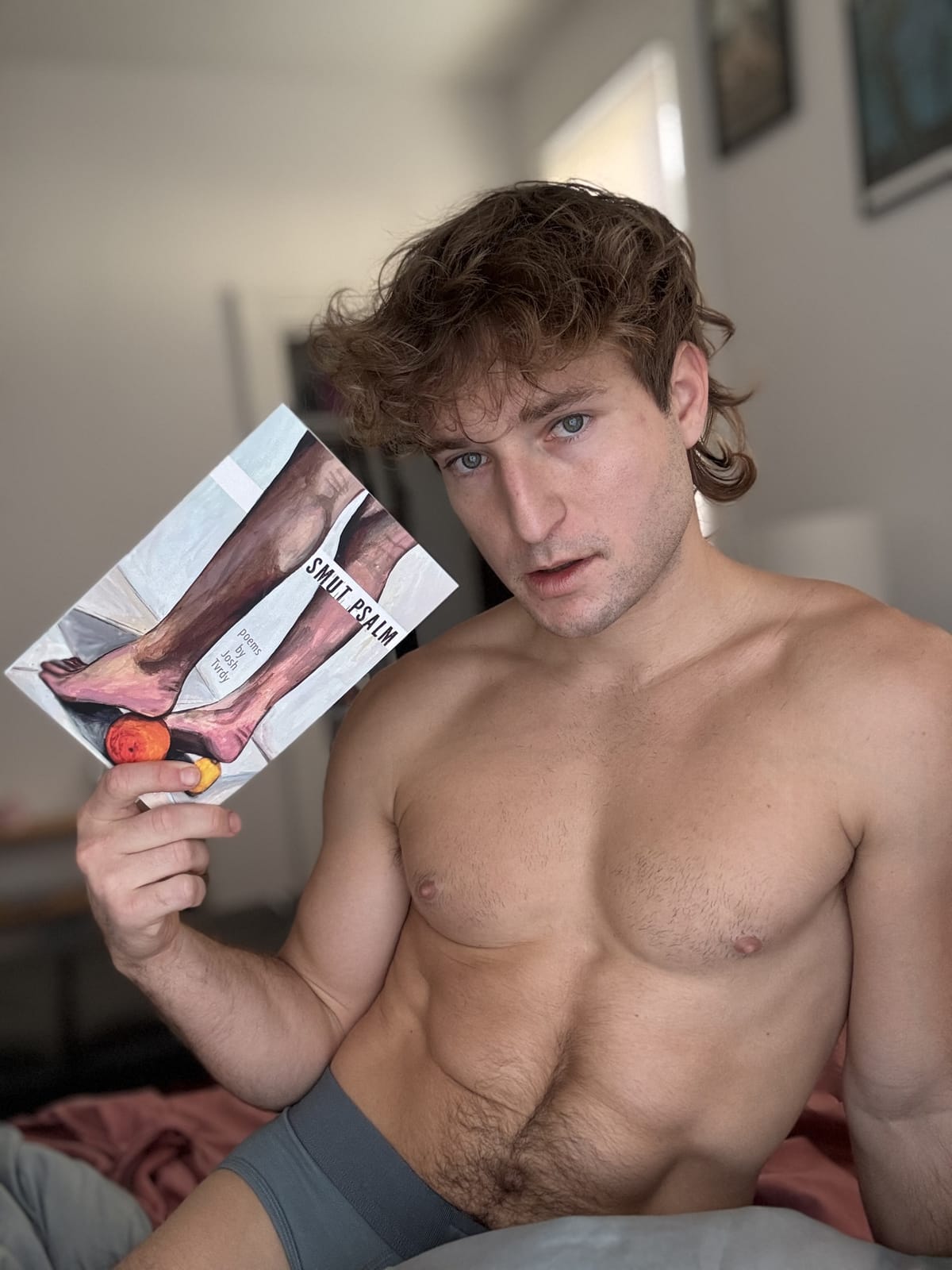
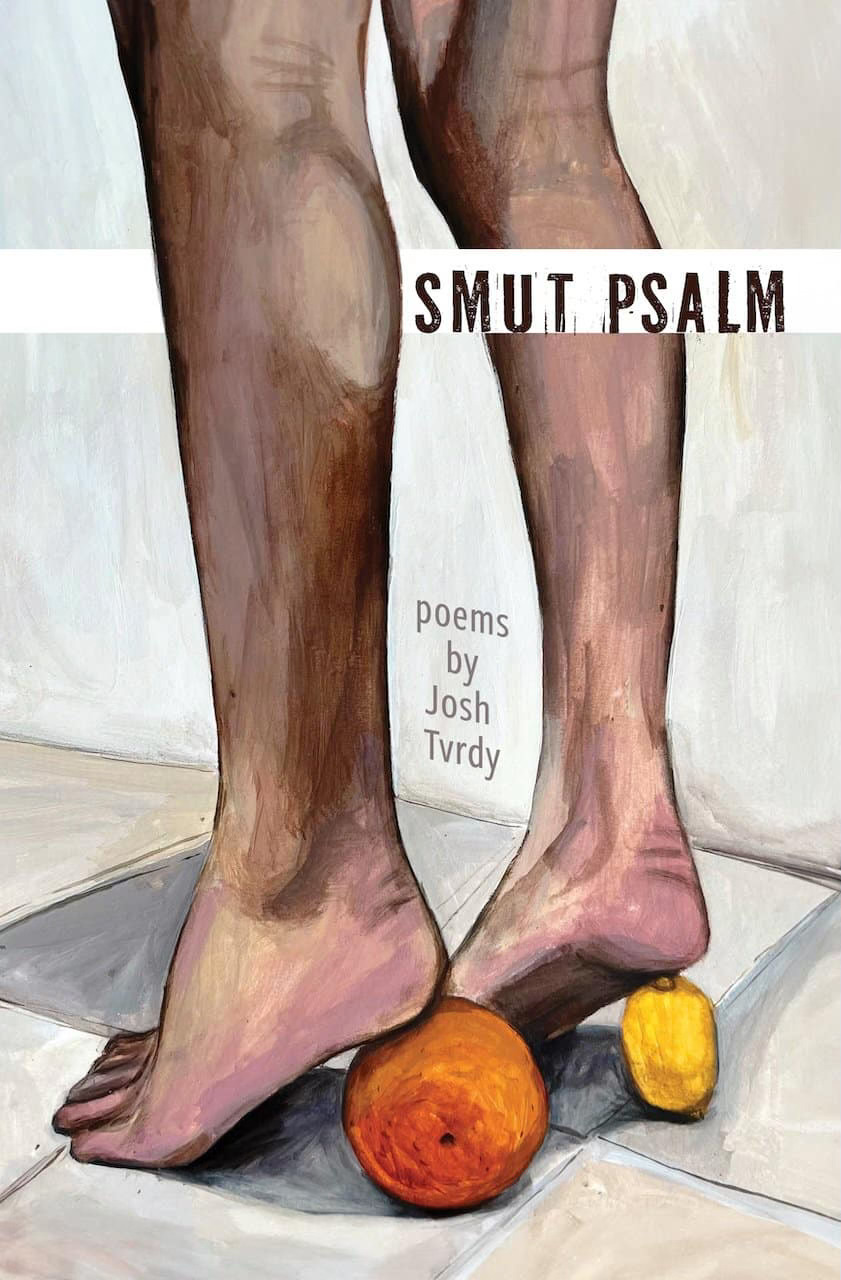
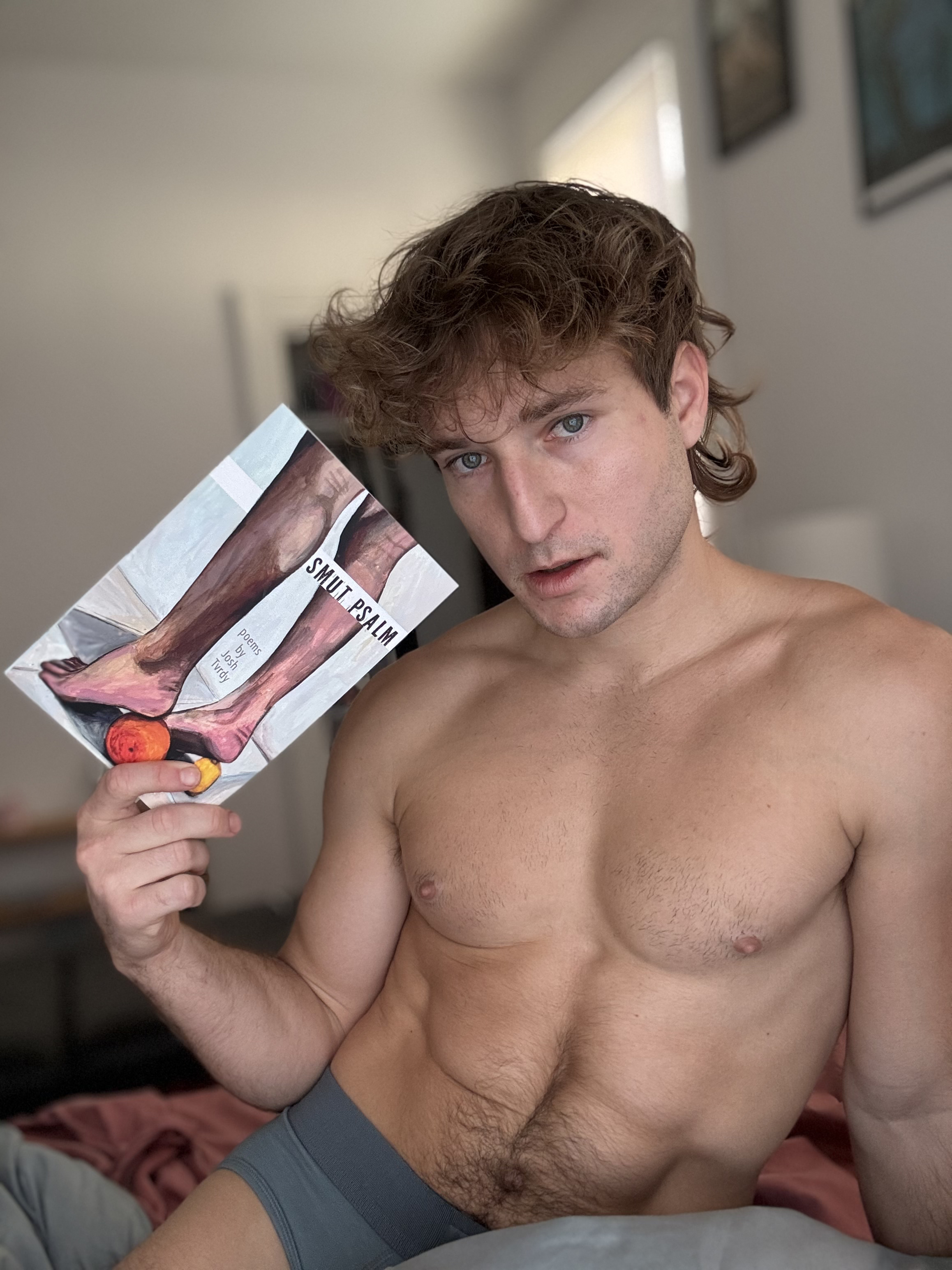
Josh Tvrdy is a poet and teacher from Arizona, living in North Carolina. His first chapbook, Smut Psalm, is the 2023 winner of Button Poetry’s highly competitive Chapbook Contest. It was published last month. Josh’s work has been published in many excellent journals and been awarded a Pushcart Prize.
Josh also has a large following on TikTok, where he has developed his own genre of short-storytelling—silly and absorbing, as packed with eroticism as the best of his poetry. I’ve really enjoyed his online poetry workshops, which provide encouraging spaces for poets new and experienced alike to work on their craft together.
Josh is a friend, a writer, and an editor whose boldness and artistry I admire, and I was thrilled when he agreed to this interview (The Rearview’s first and his first!), which we conducted over email.
– Samuel Ernest
SE
A huge congratulations, first of all—both on winning the Button Poetry Chapbook Contest and on the publication of your first chapbook. It's excellent, highlighting so much of what I love about your poems, their riskiness, playfulness, the way they press into moments when feelings like arousal and fear, shame and wonder, coincide.
How long has this project been in the works, and do you remember which of the poems from it you wrote first? What's the story of that poem?
JT
Thank you! It feels surreal, finally holding this book in my hands. Largely because most of the poems are at least six or seven years old. There's always a flicker of terror, diving into the wreckage of old work. Will I still find the poems delightful, surprising? Happy to report: the poems still surprise me.
I'm pretty sure the Church Board Interrogations (CBIs) were the first poems to be written for the project. I was twenty-two, moving through a strange and soul-crushing fifth year at my undergraduate college. I was an assistant coach for my collegiate cross country and track program, making $8,000 for the entire year, on fifty-five hour work weeks. I was taking a nearly full class load. I was applying to grad schools. I couldn’t afford WiFi and watched porn via a flash drive my friend had given to me, out of pity.
The CBIs were a glorious symptom of my frantic schedule. I didn't have enough time to be overly serious. I didn't have time to agonize, or overthink. My life felt flat, harassed, compressed, and so my language started getting stranger, curvier, more playful.
I was also coming into gay sex/desire in a real way, while simultaneously working through my old religious wounds. On Saturday nights, I would drive fifty minutes to Peoria, Illinois, to a gay bar named Diesel, whose playlist was mostly (and bafflingly) 50 Cent and Eminem. And on Sunday mornings, still scrimmed in clubsweat, I would don a robe and serve communion to my Lutheran congregation. Club rat by night, assistant minister by day. I can feel that clash in the chaos of the CBIs, and in Smut Psalm as a whole.
SE
The interrogations in the CBIs have a similar structure to the Catholic confessional. They remind me of “Translation of the Confessionario into the Local Dialect,” from Randall Mann’s first collection, which you introduced me to. Your interrogators are much more direct than Mann’s priest, asking not “In order to take the turtle, did you pray?” but “Would you consider yourself a sodomite?” The harder the interrogators press, the more slippery the speaker becomes. “I was a rainbow—greased, gone,” he says.
The images you conjure tend toward the absurd, like SpongeBob as “a walking wall of glory- // holes.” When the speaker discloses an element of his erotic history, it's also absurd: “Once I fucked a schnauzer-gay whose hole / was hairless, pristine // as his gleaming Mini Cooper.” By not overthinking or agonizing over the CBI poems, you've shown that the confessional may still be a site of queer formation, and you’ve offered a vibrant queer aesthetic within that space.
Were there vibrant elements of your Evangelical (yes?) life that fed your queerness, or did queerness always come as an escape?
JT
That's very generous. Always happy to put the anal in confessiANAL.
I was indeed brought up evangelical, but a very particular form of evangelicalism. A coffee-shop-in-the-lobby evangelical. A Wal-Mart-turned-sanctuary evangelical. Five thousand congregants battling boredom in the sorts of chairs you'd find in hospital waiting rooms.
Growing up, immersed in the church, I didn't have an awareness of queerness. Or if I had an awareness, queerness was a threatening haze just offscreen. Even in the look-back, I can't really identify much vibrancy in that sort of evangelicalism. Let alone a vibrancy that informed my fledgling queerness. Of course, there were flickers of delicious strangeness. For example: before my pastor was a pastor, he made his money breeding betta fish until the relentless betta breeding became a form of idolatry (#camp). But never more than a flicker.
I wanted my speaker… to be just as slippery as mystery itself.
It was a form of Christianity that rutted around in its hopelessly chrome contemporariness. It jettisoned anything it deemed extraneous, or purely aesthetic: no iconography, no traditional hymns, no liturgy. We didn't even take communion (much to my Catholic grandmother's horror). It's like my church was afraid of mystery. And frankly, they had good reason to be afraid of it, because mystery is slippery, elusive, impossible to control. And despite how loudly they screamed LOVE, control was at the core of their values.
I wanted my speaker in the CBIs to be just as slippery as mystery itself. And I wanted the evangelical interrogators to be slippery as well, but in a smothered way. Why do they keep the confession going, poem after poem, despite no clear progress? Pleasure, of course. They're disturbed and titillated, both at the same time. They're trying to batter free a confession, sure, but they're also siphoning the speaker's queerness for a poppers high.
SE
What you've said about control makes so much sense, and the order of the poems illustrates that, too. The CBIs open and close the book, and they punctuate it regularly throughout. When we aren't in the interrogation room, we are often at home with the speaker, where the speaker's father lurks, threatening violence.
"Desert Nights (Middle School)" is a poem that comes early in the collection. It contains the father (sleeping) but places him within a vaster landscape. It's a reframing, gesturing to a world beyond church and home.
The short poem has several mini wet vignettes, and at its center is a wet dream: "I dream of older boys, shower steam, sour towels." Touch and sensation are important in the book, but wetness really saturates it. Could you elaborate on the choice to include a landscape poem, particularly a desert poem, in the collection and maybe share a couple thoughts on wetness?
JT
This poem was the direct result of a nudge from the fantastic poet Eduardo C. Corral, who was my thesis advisor in grad school. He identified a setting gap in my manuscript. It contained the hazy domestic, the surreal dream-space, but no literal physical grounding. So he introduced me to Keith Ekiss's Pima Road Notebook (2010) poems, gorgeous image-based poems that foreground the desert landscape, which happened to be the landscape of my childhood adolescence (I actually grew up in Pima County). Eduardo was born in Casa Grande, just an hour north of Tucson, so there's a lovely little desert trinity behind this poem's image-life.
The poem is doing a few things for the manuscript. It lodges the book in a real, textured, spacious world: a vital counterpoint to poems like "Raising Children God's Way" and "Re-Translation," which are parched with domestic density. It also lodges desire in the landscape itself. Everything is bodied. Everything is just as penetrable as the rotting grapefruit that appears in the poem. Which is both alluring and horrifying for the speaker, who has been taught to fear his own desire.
About the wetness... fluids turn me on. The slickness! The sheen! The way fluid on fabric stains the fabric a deeper version of itself! But also, I love the dual nature of wetness. Wetness is a requirement for life, for growth, especially in the desert, where all moisture is scarce. But too much wetness is a flood. Too much wetness corrodes.
SE
Earlier you said that you're "happy to put the anal in confessiANAL," and I want to ask about that. Aside from church confessionals and interrogations, do you see yourself working in a confessional poetics or tradition?
JT
Throughout the years (half playfully and half seriously), I've referred to my poems as hyper confessional. The confessional stretched to an absurd limit. Poems that probe subjects so intimate, so taboo, so on the edge of oversharing, they might actually make the reader writhe. Whether the reader is writhing with pleasure, or disgust, or a combination of both—that depends on the reader lol.
Anne Sexton (widely considered a leader of the confessional movement) is my desk-poet. And by that, I mean she's always on my desk, within reach, if my writing feels flat or if I forget what's possible on the page. She's so brazen, so bold. Obliterating shibboleths with poems about sex, ambivalent motherhood, abortion, mental illness, the body—back when those subjects were ridiculed. And not just ridiculed: feared.
She slid those forbidden subjects under the poetry microscope, and discovered—through the sheer force of her wide-ranging craft—complicated human truth. I needed (and still need) a poet like her. Someone to remind me: there are no untouchable subjects. Said another way: it's not what you're writing about, it's how. And if there are deep ravines of human experience largely ignored by "capital-P poetry"... why not write from those forbidden places?
SE
Yes—and if there is a good news according to Josh Tvrdy, it's something like: There are no untouchable subjects.
Touching the untouchable through language introduces it to certain kinds of form. Like you say, "It's not what you're writing about, it's how." Let's get into the how. What does writing about the abject or the taboo open up in the realm of poetic craft? And from another direction, does poetry allow untouchable topics something that other forms don’t?
…gild the disgusting with absurdity's lube.
JT
Leaning into the abject/taboo loosens my poetic approach. I take myself, and my subjects, less seriously, which, ironically, often leads to serious revelation. I think this is most evident in the Church Board Interrogations, but you also see it in other poems (like the cucumber sex-poem duo). An acidic, bizarre sense of humor slips inside the poem, quite seductively, to gild the disgusting with absurdity's lube. Joan Didion has Slouching Towards Bethlehem. I've got Cackling Towards Filth-&-Phlegm.
Many people, in my opinion, look down on comedic poetry. As if its presence cheapens one of society's "last pure art forms." But purity? A sham, wherever we find it. And witheringly boring. Like anything else, comedy is a rhetorical tool. And I believe it's uniquely suited to lead a reader towards profound emotional revelation. Get them laughing, then sucker-punch them with the truth. Just look at Amy Hempel, Sasha Debevec-McKenney, Diane Seuss, Lorrie Moore, Alberto Ríos, Natalie Shapero, Chessy Normile, Philip Roth: comedic architects and emotional seers, often in the same sentence.
I do think the line break, which is unique to poetry, inflects untouchable subjects in a particular way. The line break is an additional syntactical tool. We get to create sentences within the sentence. Line breaks also punctuate the sentence with little delays, little gasps of anticipation as we bridge the white space to reach the language on the other side.
When we read a well-broken line, it's like passing through a sentence's set of double-sphincters. Resistance, relaxation. Resistance, relaxation. We encounter a honey-combed interiority, alongside a sensual musicality of delay and satisfaction. Both of which feel vital to eroticism. And eroticism feels vital to the untouchable subjects that interest me most: i.e., kink, filth, transgressive desire's sweatiest crannies.
SE
You have a considerable following on TikTok (@heftytestes), where you tell compressed, whimsical, and horny stories—maybe true, maybe fiction. It's like if Amy Hempel were a gym rat twunk who wrote gay erotica. Your videos are rife with wordplay (e.g., "lobotomy"/"bottom"), and you often have your titties out for the girls.
Have you given much thought to the craft elements of TikTok? What are the formal elements of a TikTok video you like playing with the most?
JT
I will say this: I don't exactly love making TikToks. I'm about as tech-savvy as a kidney stone, so wrestling with angles and quick-cuts and SEO hashtags feels like a unique form of punishment. And though going semi-viral was an exhilarating gift, chasing that virality was such a feckless, numbing experience that it flattened my creative life for a few withered months.
Imagine my discombobulation… overnight a horde of lovely midwestern mothers and lonely gays were suddenly ravenous for scraps of my romantic life.
Your audience is perilously visible on TikTok. I still think about the man who commented, on multiple videos, in reference to my happy trail, which is more of a happy patch these days: "shave that tarantula!" Interacting with such an immediate and opinionated audience was destabilizing. I'm a poet! I write my poems with the expectation that nobody will ever read them! So imagine my discombobulation when basically overnight, a horde of lovely midwestern mothers and lonely gays were suddenly ravenous for scraps of my romantic life. It was bizarre. I learned a lot.
The biggest thing I learned was how to manipulate tone/tonality. Storytelling is huge on TikTok, but it's an off-the-cuff, conversational mode that really does numbers. Like, a casual, gossip-dipped FaceTime with your bestie. And yet, I'm far too much of a perfectionist to just press record and let the story unfold without any preparation. So I learned how to inhabit a highly crafted (and highly practiced) narrative style that retains a chatty tonality. A narrative performance so slick and seductive, it feels like improv, even though the bulk of what you're hearing is pre-written.
This unique narrative style has actually been essential to my fiction writing. I'm halfway through my first novel, which uses a first-person POV. My narrator’s voice is casual but poised, so, I'm once again aiming for that sweet spot of crafted chattiness. Chatty Craft, I call it. Which is not only an effective narrative style... it's also my future drag name.
SE
Would you be open to saying more about the novel you're working on? And what else are you looking forward to?
JT
So I don't want to reveal too much about the novel yet, until it's finished. Call me superstitious. But I can tell you this: the location is a southern gym that's secretly a den of gay cruising. It's funny. It's sexy. It's gross (aka: sexy). And it's constantly burrowing into a theme that binds and smothers so many gay lives: shame.
Shame doesn't disappear when you exit the closet. We think it does. I thought it did. But shame sticks around, truncating our lives/sex/friendships in particular ways. I'm talking shame with a capital “S.” Dom Daddy Shame. An existential unworthiness that hides inside like a second heart. Which sounds like a joyless theme for a novel, but I'm having an absolute ball.
Beyond the novel, I'm looking forward to a little Smut Psalm book tour. It's the evangelical in me. Gotta spread the gospel! I'm still scrapping the logistics together, so if you're reading this and you're like, I want Josh to read in MY city, please email me at jwtvrdy@gmail.com.
I'm also sitting on a secret. Well, a pair of secrets: two full-sized poetry manuscripts, fully finished. They haven't found a home quite yet, but they will soon, fingers crossed. So if you liked Smut Psalm, take heart! There's a whole damn hymnal (hymanal?) yet to come. <3
Smut Psalm may be ordered from Button Poetry here. To keep up with Josh’s work, follow his socials here.
If you enjoyed this interview, subscribe to The Rearview! And/or share it with a friend. If you already do subscribe, consider supporting our work with a paid subscription ($5/month or $50/year) or joining the Founding Circle ($150/year).
Business update
Homodoxy is now an LLC! Going for nonprofit status, although attractive in many ways, seemed iffy given the incoming regime. I am applying for a grant that would allow Homodoxy to publish its next book. It will be a collection of Kevin Gordon’s writings, published and unpublished, in tandem with my academic work on the development of gay theology in the midst of AIDS.
In lieu of a sugar daddy dropping a steaming pile of… sugar into our coffers, Homodoxy’s catalogue will depend on more and smaller streams of revenue. So, if you like what you’ve been reading and would like to help Homodoxy produce books, support The Rearview. I am extremely grateful to my, so far, one paid subscriber!!! (Love you, girl.)
Book received
I received my copy of William D. Glenn’s I Came Here Seeking a Person: A Vital Story of Grace. Bill is a therapist, a former Jesuit, and the chair of the board of trustees of the Graduate Theological Union in Berkeley. He’s done a lot, and you can learn more about him here. He has been an active participant in the history I’m learning and writing about, and I am so grateful that he is a subscriber. I’m looking forward to reading his story. You may find copies here.
Thank you all, and happy New Year.