Miss Appearance
naming, disappearance, and transformation
Maybe even just recording these voices makes them louder, women who for many years hid the events in silence, like someone who refuses to recognize the brutal evidence in themselves. . . . The corroded history gagged by bureaucracy and democratic indifference.
We need to say a thousand times that this happened, that this took place in neighborhoods not far from here.
– Pedro Lemebel, “Act Like Nothing Happened, Dream It Never Could,” in A Last Supper of Queer Apostles, translated by Gwendolyn Harper
In the year 2025, people may begin to disappear from public life in the United States. The disappearance of some is already tolerated by the public—Latine immigrant families deported and Black people incarcerated or shot by the police. Although I’m talking about people in the United States, hundreds of thousands are currently being ground into dust and emaciated by US foreign policy, notably in Gaza and Lebanon. This has already been happening. All of this would have continued under Kamala Harris, and will continue under Donald Trump at an accelerating rate. Trump told Time that he would deport 15 to 20 million people. The plan would implemented by local law enforcement.
So, in the year 2025, more people may begin to disappear from public life in the United States. The darlings of right-leaning Democrats and the never Trumpers, like Liz Cheney, a torture apologist whose father shaped policies that killed hundreds of thousands of civilians in Iraq and Afghanistan, along with the left-leaning Democrats like Alexandria Ocasio-Cortez, who, although one of the few American politicians to eventually call Israel’s actions in Gaza a genocide, spoke at the Democratic National Convention in support of candidate Harris while Palestinian Americans were prevented from speaking. Trump has said he would like to prosecute and jail his political rivals, and that is potentially a large pool, including many who aid the US’s projects of deportation, genocide, and silencing. Should he keep his campaign promises, the tyrant will take up the state’s project of disappearance and turn it against itself. The state will eat its own.
Maybe it’s an alarmist idea to entertain, but Trump is an entertainer. Maybe the courts would try to stop him, but he will have opportunities to appoint more willing judges.
If political prosecutions do start, activists and academics will be targeted, too. Trump and other Republicans have said they would like to deport students who protest Israel’s genocide in Gaza.
Two weeks ago, my university’s new Committee on Institutional Voice announced guidelines to support “open and free academic exploration and the pursuit of knowledge.” While faculty and students are allotted “broad freedom to speak, including to take positions on issues of the day,” the university’s leaders are advised to “refrain from issuing statements concerning matters of public, social, or political significance, except in rare cases.” There may be “events of public, social, or political significance” that “directly implicate the university’s core mission, values, functions, or interest,” in response to which “it may be appropriate for university leaders to speak.” And there may be times when it is “appropriate for university leaders to make statements of empathy or concern in response to events outside the university,” but only on matters “of transcendent importance to the community.” The committee adopts these recommendations, or “presumptions,” in order to preserve the free exchange of ideas and to avoid marginalizing members of the community who may disagree with a pronouncement. A decision “by leaders not to speak on a given topic need not be understood as a substantive position on that topic,” but instead be a choice to foster free speech. This impetus to silence that fosters free speech “should apply to all leaders at all levels in their official capacities.” The Institutional Voice is to be used judiciously, or better, not at all.
Were this report issued in a vacuum, it would be innocuous enough. But with any amount of contextualization, it becomes more curious. The past year has seen pro-Palestine protests and encampments in response to which the university’s police arrested and intimidated students and used violence against members of the community, while the administration threatened disciplinary action. The university’s response has not been harsh enough for disappointed Republicans in the House Committee on Education, who are watching our campus and others. On October 31, 2024, they issued a report called “Antisemitism on College Campuses Exposed,” which predictably calls pro-divestment, anti-genocide protests anti-Semitic. The intent of the report is to put pressure on universities to bring harsher consequences to students exercising varieties of free speech that house Republicans and Zionists on campus find offensive. It recommends reassessing the allotment of government funds to these universities, as they have “failed to meet their obligations to protect Jewish students, faculty, and staff.” Students demand their universities divest from genocide; Republican lawmakers push universities to legal action or threaten to pull funding.
The university will prioritize profit over student protestors and the victims of Israel’s violence. It already has. In April of this year, another university committee, the Advisory Committee on Investor Responsibility, determined that investing in weapons manufacturers arming a genocidal regime does not violate their principles for ethical investing. The endowment of the university’s divinity school is included in the same portfolio and is managed by the same people. The divinity school, which has leading Christian ethicists on faculty, has no say (and perhaps wishes not to have a say) in the ethics according to which its endowment is handled. What is a good Christian defense for investing in genocide? Thanks to the new guidelines on Institutional Voice, the administration may claim it is doesn’t have to answer this question. Genocide is an important issue, sure, but is it of “transcendent importance” to the community? Well, if you call it genocide, maybe, but what if we don’t call it a genocide? For the university of lux et veritas, and for its divinity school, refusing to speak truthfully is good business.
What kind of faggots are we now? What kind of Christians?
Some people explicitly deny the existence of Palestine and the Palestinian people. Others may speak of a Palestine and a Palestinian people while refusing to speak of the ethnic cleansing of Palestine or the genocide of Palestinian people. This is no different. Ahmed Moor calls the former a politics of denial. In “Presence, Memory and Denial,” an essay in After Zionism: One State for Israel and Palestine, he writes, “The politics of denial is the politics of occlusion and erasure, of negative spaces and dark holes. It is a manic, hysterical and angry politics. It is sometimes the politics of atrocity.” The politics of denial is not only a denial of a Palestinian presence, though. Through efforts of the Israeli state and academy to erase the Nakba described by Moor and historians like Ilan Pappe (see his chapter in the book)—and now through various efforts of American and Western institutions and states to erase the genocide by calling it a conflict or war—the politics of denial can also be the denial of a Palestinian absence, a Palestinian past. When a people suffers a genocide, denying or refusing to name the genocide is also a denial of the people. If you thought they were people, you would care to name their extermination properly.
Words lose their meaning. Bullshit accretes in layers of protection. Universities adopt methods of voluntary self-silencing that, as the government seeks to establish new definitions aimed at ideological control like the IHRA definition of antisemitism, could easily serve as a defense for compliance. The police will come knocking. Universities will betray their own.
Here, my dad might remind me of the first dictum in Timothy Snyder’s On Tyranny: “Do not obey in advance.” When authoritarianism is imminent, people and institutions begin to adjust before the new order even arrives. Snyder calls this “anticipatory obedience.” Following Trump’s recent win, Gabriel Winant writes, “powerful actors in our society [will] tacitly defect to the fascist cause. Indeed, they already have been to do so, validating Trump’s politics while declaiming his manners, which was exactly how Trump won again. Liberal corporations, the press, the universities—institutions that deplore Trump in name—have shifted in recent years toward carrying out elements of his program in miniature, seemingly uncoerced.”
Who knows, who knows. Jailing dissenters is what Trump says he wants to do, and it’s what history would seem to suggest will happen. I’m not a prophet or a particularly adept political thinker, but I am trying to expand what I think about and what I write about beyond theology, literature, and sexuality while learning from my study of theology, literature, and sexuality. If I am not convincing, if I stroke the paint too broadly (that’s not right, is it…), forgive me. I want to be prepared for the coming proliferation of manufactured silences and to think well amidst them. One of the taglines I’m playing around with for Homodoxy is “books worth burning,” because fascists are already coming for our libraries and banning books. Now is the time to write and read more, not less. To say things that have been difficult or uncomfortable to say, and may become increasingly dangerous to say.
If a period of intensifying repression is to come in which criticizing Israel, “saying gay,” and voicing support for freedom of gender and non/reproduction are verboten, what kind of faggots will we be? What kind of Christians? The silencing and disappearances have already begun. The sudden panic of many people at the announcement of a second Trump term can be read as a collective reckoning with that (or failure to). What I have tolerated as acceptable treatment of my neighbors may soon be how I am treated, and I don’t want that. What kind of faggots are we now? What kind of Christians?
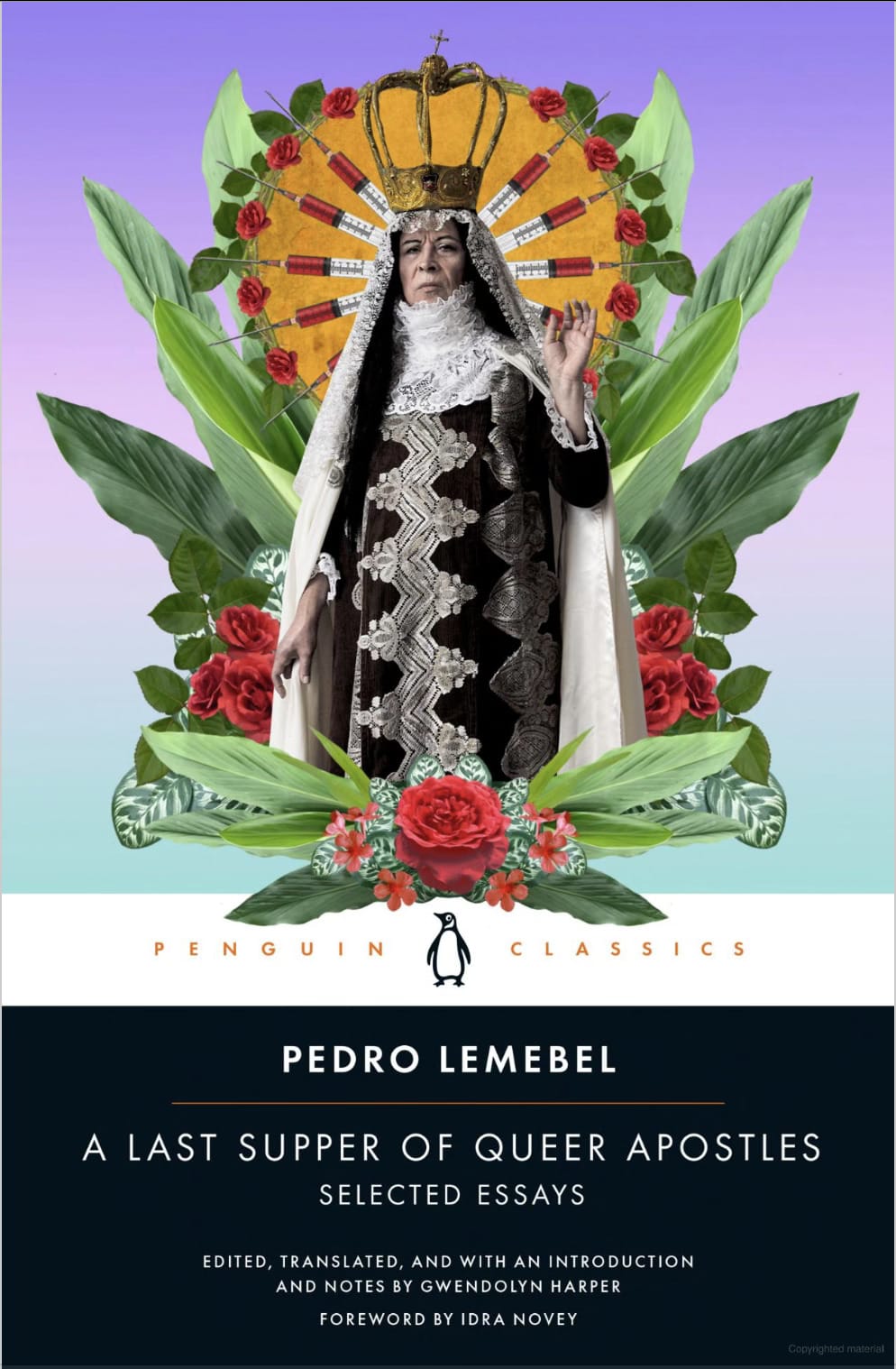
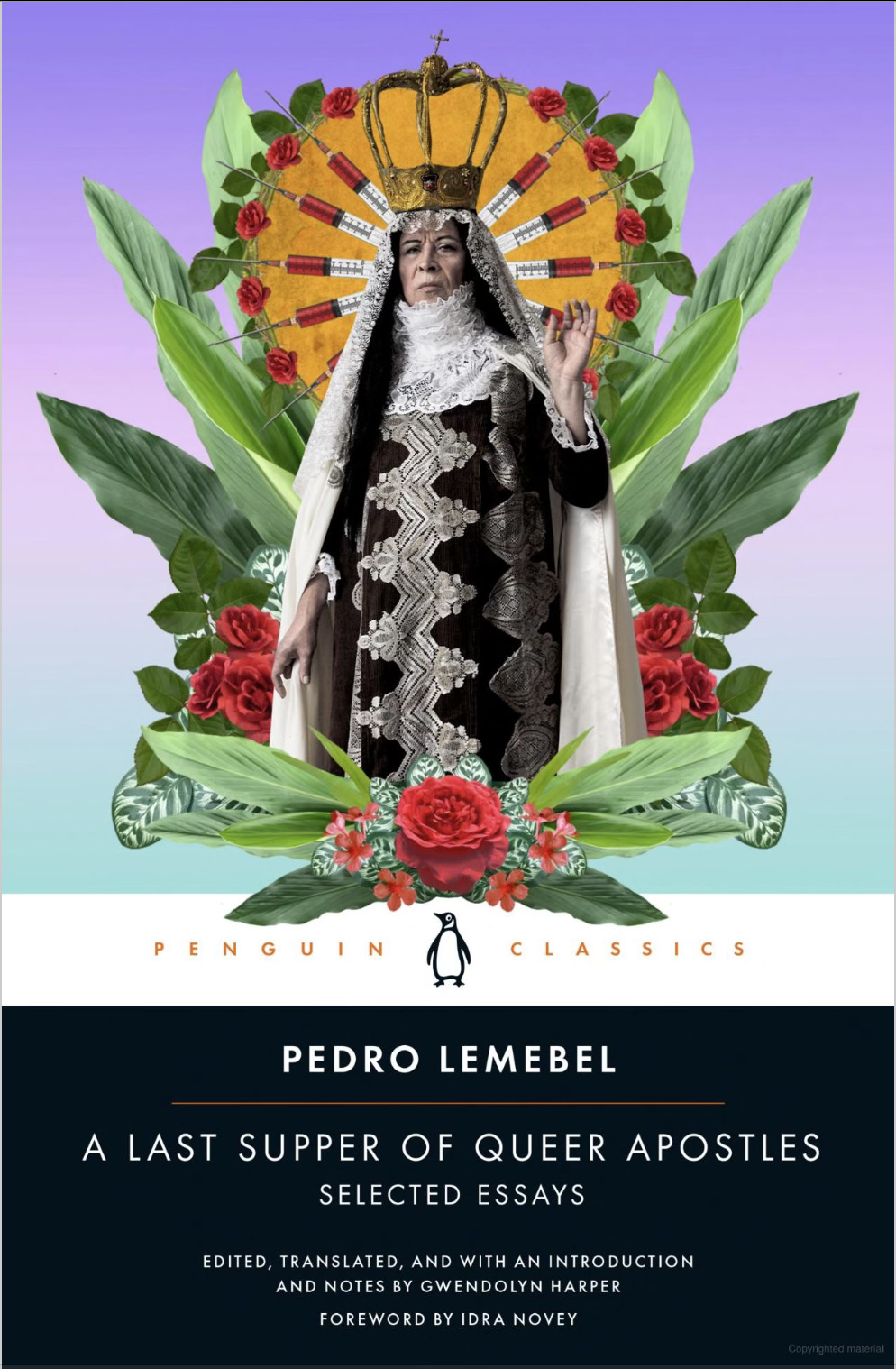
The cover of A Last Supper of Queer Apostles is striking. The book is the selected essays of Pedro Lemebel published in translation this year by Penguin Press. On its cover, the author stands in a gown and veil, with her hand raised, not quite in the blessing of the pantocrator, but some cross between a wave of recognition and a gentle “stop.” She pulls her eyebrows down in concern. Lemebel is crowned with gold and haloed. Blood-filled syringes radiate outward from her head, poking out beyond the halo’s diameter, which is lined with flowering red rose vines. Here is a bloody Mary, a loca Madonna. “Loca” is a slur reclaimed by trans women and effeminate men (who may not identify as either of those things) living in Spanish-speaking American countries like Chile, where Lemebel lived from 1952 to 2015.
Lemebel’s locas are figures of agony and ecstasy. They are saintly in that sense.
Lemebel called his short, vibrant essays “crónicas,” and most of A Last Supper take that form. They are fabulized vignettes of queer life in Chile in the wake of the US-backed coup that removed Salvador Allende from power in September 1973, resulting in the Pinochet regime. In her introduction to the new volume, Gwendolyn Harper writes, “During the weeks and years that followed, thousands would be detained and killed—collectively known as ‘the disappeared,’ as most of the bodies were never recovered, nor their deaths confirmed.” Lemebel writes of the queer sexual culture that grew in the shadows of Pinochet’s regime (“Anacondas in the Park”), abduction and disappearance (“Pisagua on Pointe,” “If You Don’t Return”), locas who pursued pleasure and found death (“Where the Music and Lights Never Went Out,” “Even Poppies Have Thorns,” “The Death of Madonna,” etc.), acts of protest (“Flash Art Politics: Three Tales”), the blond American gays who colonized and commodified sexual desire from Chile to the Stonewall Inn (“New York Chronicles,” “Hot Pants at the Sodomy Disco”), as well as the queers who sought to befriend the fascists (“Black Orchids,” “Gonzalo”). Lemebel writes sensuous metaphors and descriptions. His words smell and grasp.
Lemebel’s locas are figures of agony and ecstasy. They are saintly in that sense. Their desires spring up. They leap into life and out of it, in one instance, leaping out of the third floor of a burning building, Club Divine, in a final performance witnessed by a crowd assembled below. She jumps “because just maybe she’ll float down on the golden air that’s now burning in her lungs.” The loca clings to a scrap of possibility like a swinging rope.
Lemebel’s locas are quick and funny. They give their friends nicknames that transform unseemly features into cherished ones: “La Silicone María… La Windbreaker… La Coupon Queen… La Blowjob Minister… La Risky María.” A loca’s nicknames “hide the baptismal roster, the father’s mark consecrated in his butch offspring.” There is a “poetics of the gay nickname,” Lemebel says, that “generally goes further than just identifying someone: the name disfigures, smears any features recorded in bureaucratic registers.” The church name, the name from the father, the name known to the government—these must go, replaced by proliferating ways of naming and entertaining one another. When AIDS enters the scene, the locas draw the deadly virus into their life-giving naming: “La Kool-AIDS… La Lynne-phoma… La Gone with the Wind.” Naming not only entertains but heals. Lemebel writes, “Ten thousand ways to make a seropositive friend laugh, so that depression doesn’t weaken her immune system. A million tiny distractions to get her laughing at herself, mocking her own drama.” At the club, one friend tells another, “That sarcoma looks fabulous on you, girl! And so the sick are taken for healthy and the syndrome’s stigma becomes another one of the club’s features.”
Lemebel sees AIDS as flowing through a channel already carved out by a masculine and consumerist gay identity imported into Chile from the States. In “Wild Desires,” Lemebel speaks of gay liberation as “a gay movement we didn’t participate in, and yet we catch its deadly hangover.” He contrasts the “international gay parade” found in “imported fashion magazines” and visions of life in California with the lives of travestis and locas in Santiago, writing, “Class separates the locas, homos, and travesties from the comfortable gays who scramble up the ladder.” Locas are seen as “crazy” women. They preserve a “maternal mestizaje” from the “blond militarism and golden musculature,” guard their “madwoman geography” from masculinizing discourses. Locas don’t see themselves in this new gay aesthetic. Gay is a capitalist identity; it “fastens to power.”
In “Night of Furs,” Lemebel looks at the sole picture from a New Years Eve decades earlier in 1972. “Everyone was invited,” the broke locas and the rich locas alike, the streetwalkers and the daughters of high society. The girls stack the bones of their dinner, turkey, on the table in a large pyramid, “like a mass grave lit by candles.” Lemebel—or his narrating surrogate—looks at the blurry picture of locas in motion through “the stained tulle of AIDS” that “shrouds almost every loca in a double disappearance.” He remembers their deaths. One well off loca, la Pilola Alessandri, “purchased the epidemic in New York, the first one to bring it back, the genuine article.” It turned her model thin before killing her. Another, la Palma, swelled up “like a condom blown up by the wheeze of her pious asshole, the asshole that never stopped giving, echoing with tambourines and timbales in the passion of AIDS-wrought diarrhea.” The photo isn’t great because the locas wouldn’t’ stay still. “It might be mistaken for a biblical frieze,” Lemebel writes, “a Holy Thursday watercolor.” Yes, it’s “practically a last supper of queer apostles, where the only things clearly rendered is the pyramid of bones on the table.” The locas are gathered around, not Jesus, but a pile of bones, an omen of what will come for the colorful figures surrounding it.
This picture, and the locas within it, are an image of life before the dictatorship “forced masculinity into our mannerisms” and before the locas were “kaposied by AIDS, but decimated first and foremost by an imported model of being gay, so fashionable, so penetrative in its angling for power, the masculine homosexual supernova.” Fascism and the influence of gay culture in the United States conspire together to produce an icon of power-hungry masculinity that the locas reject. If the photo is a Last Supper, it is also an Dionysian Eden “from an era before the plague spread to native lands, recolonizing via bodily fluids.”
In one vignette, the locas are disciples; in others, they become emanations of the Holy Mother. The Virgin Mary makes an appearance toward the end of the collection, in “The Transfiguration of Miguel Ángel (Or, ‘Faith Moves Mountains’).” Forgive me as a spoil the entire story for you.
Lemebel explains how, according to the politics and media climate of the day, the Virgin Mary occasionally appears in Chile, through a variety of media. Tree bark, Coca-Cola bottle caps, the shattered window of a brothel—“in short, just about everywhere, without warning, the Mother of Christ reenacts her glowing performance to the first person who sees her,” transforming her chosen audience member into a healer. Mary is herself a performer. She likes a bit of drama and intrigue.
In the time of Pinochet, Miguel Ángel, an orphan from Villa Alemana, sees a woman in white on a hill. The town gathers in excitement. No one sees the Virgin but Miguel Ángel, who enters a state of ecstasy and speaks in tongues, causing many to believe. An exorcist priest is summoned, but he neither sees nor believes. He nearly goes crazy trying to understand how this could have happened to a mere orphan, not a man who spent his entire life in devotion to the Virgin. He pleads, “Why, Señora, did you appear to this heretic welp. Why do you refuse me your presence…” and he goes on. Following his investigation, the priest sends up his report, saying the appearance and the boy’s subsequent powers of healing are a sham, “collective suggestibility.” This does nothing to quell the boy’s popularity; on the contrary, it makes fans of “the many faithful who distrust the church.”
Eventually, the boy travels abroad. The people forget.
Years later, a paper announces that Miguel Ángel will return to Chile. Journalists greet his plane to greet the one-ttime wunderkind, but the passengers vacate the plane, and no one sees Miguel Ángel. But then, Lemebel writes, “a girl with long hair and dark glasses approached them,” and asks, “Don’t you recognize me? I’m Miguel Ángel. The Virgin made me a woman.” A TV special is made about this new miracle. The bishop condemns the loca’s claims, saying the Bible “doesn’t accept sexual operations with mystic scalpels, or sodomite tricks.” The exorcist priest sees the special on TV, and has a different reaction. Now an old man, he testifies “that the Virgin had finally given him proof of her grace, that, after so much pleading, María, touched, had appeared to him in the flesh through Miguel Ángel’s transfiguration.” Like Thomas, the priest needed to see the body to believe. And like Simeon upon seeing the Christ child, the priest dies having seen what he needed to see.
Again, time passes. The villagers and the country forget about the hill and the beautiful young woman. But one group remembers. Lemebel writes, “Way up there, in the middle of the night, another kind of visitor still makes the trek, camouflaged in the shadows: the travesti pilgrims who climb Peña Blanca’s slope, carrying their high heels in one hand. Ladybirds who want to be women, destitute transsexuals who don’t have money for the operation, nudist hermaphrodites who expose their prostates to the moon, hoping for the heavenly axe.” The faithful locas tend to the hill, their sanctuary, leaving candles and praying to the Virgin, asking to be transformed. Lemebel imagines locas as a religious community, an order of sisters with their own special place of pilgrimage. They are drawn into the vision of Miguel Ángel, and I want to be in that number, too.
Take your heels off and climb the hill.
Memory is a theme for Lemebel. Compare the forgetfulness of the people in “The Transfiguration of Miguel Ángel” with another mass in the bleaker story “Black Orchids.” A glamorous woman in the literary world and a friend of the dictator, Mariana Callejas holds parties attended by the nation’s elite. Her lovely garden covers up the scent of the laboratory below the dance floor in which Mariana’s husband makes “exterminating elixirs,” chemical gasses ostensibly used, she says, to kill rats. The truth is more horrifying. While Mariana entertained, her husband tortured. Lemebel writes, “Surely no one knew about the other dance going on below, where a metal prod would twist, drawing tortured backsides into volcaic arcs.” The honeysuckles in the garden disguised the smells, and the disco music camouflaged the screams of the tortured. Guests may have caught the occasional unsavory whiff, or heard a suspicious cry, or wondered why the lights and music flickered on and off sometimes, but “the whole country knew and kept its mouth shut, everyone had heard something, something was said, some piece of gossip or cocktail tidbit about a censured painter. Everyone saw but chose not to look, not to know, not to listen to those horrors that leaked in through the foreign press.” The delicate dance of not knowing continues until an investigation exposes the true. The fabulous guests dissipate and deny.
In the story of Miguel Ángel’s miraculous visitation, as well as in his stories about the violence of the Pinochet regime, Lemebel draws attention to an event and memory of the event. In times of dictators and disease, witnessing to disappearances and transformations is both a duty and a way of lasting oneself. Hold onto the picture. Ask where your friends went. Take your heels off and climb the hill. Bring a candle. Not everyone will believe when it happens, and not everyone who believes will remember, but you will want to tell others regardless.
In the epigraph I’ve chosen, Lemebel responds to the horrors of fascism with a mandate. He says, “We need to say a thousand times that this happened, that this took place in neighborhoods not far from here.” For a couple of years, I’ve encouraged students and activists and whomever I can to keep a journal in case the worst does happen and because for some, the worst is already happening, and what you have been doing in the midst of that matters. As a mirror or record, or both.
Lemebel’s remembering isn’t a pious attempt to preserve the pristine truth. His stories become fables, dark or light or a shimmering blend, chastening or moving or both. With his imperative to speak comes a lesson: life exceeds words. Not everything can be put into narrative. So, Lemebel witnesses to those voices and sounds that exceed even his own gifted articulation. He writes, “Just past the edge of the page you’re reading burbles a Babel of foulmouthed, unreadable voices, always giving the slip to any definitions that literature has sussed out of them.” Trying to force such voices into narrative risks following the Catholic colonizers who killed the Incans because their emperor Atahualpa, when he held the Bible to his ear like a conch shell to listen for the Creator, didn’t hear “the hush of the mountains or the echoes of the sea,” and threw it to the ground.
To say that not everything can be named is not to excuse those who refuse to call a spade a spade out of self-preservation. In the situation of Palestine, silence and unclarity are crucial tools of the ongoing colonization.
To say that not everything can be named is rather to acknowledge that even precise words that have been fitted to particular situations for the sake of specific interventions—like ending the genocide in Gaza—cannot hold the breadth and depth of the reality they are designed to name. There is more horror, and more love, in Gaza than can be comprehended. The challenge, ultimately, is not just to wash away the bullshit and to find the better word, but to end the horror and sustain the love.
With regard to what kind of faggots, what kind of Christians, we will be if the repression worsens. I can only hope we will speak and be transformed.