The Existential There: James Loop's Metronome
What’s seen can’t be unseen. We are not removed from time, not removed from history, not floating above it all; we teem within it.

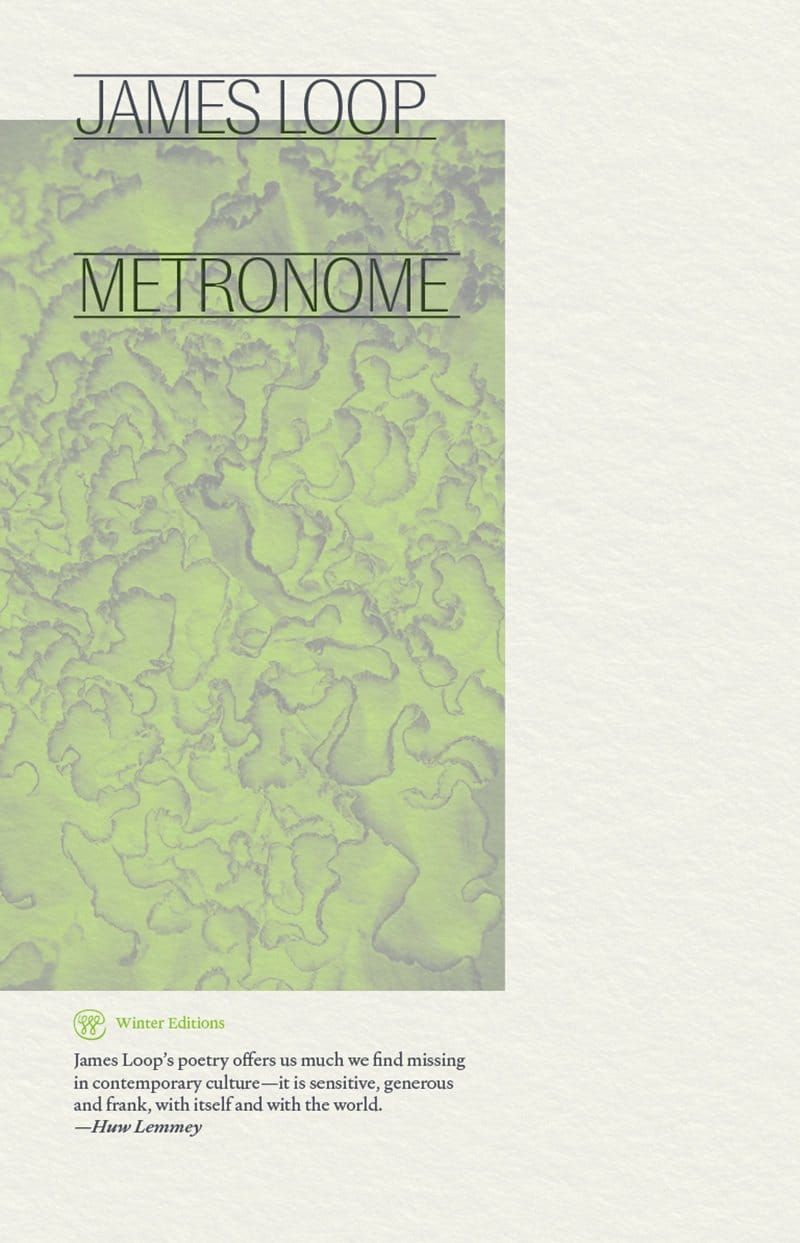
The title of James Loop’s debut collection, Metronome, just published in a gorgeous paper volume by Winter Editions, sends me back decades. I’m in the living room, where I practice violin for hours with my mother and sister heading out the door to ballet rehearsals and my father walking up and down the hallway, from his office to the kitchen and back. I stood there like a flamingo—right foot on left knee, and switch—while my left hand’s fingers frittered, my right arm flapped around to draw sound out of the instrument, my mind wandered, and the rest of my body jittered in containment. I try to make music while the intimate industry of family life goes on about me.
The metronome I used wasn’t one of those elegant wooden things with a slender arm and adjustable weight leaning this way and then that, but a small, rectangular, plastic box. A little black brick on my music stand. It had a knob in the middle for setting its speed a little red light that flashed out its beats like a warning. It could also produce an A 440 for tuning purposes. Its A was a metallic wail, more alarming than objective.
I used the metronome to run scales and etudes. Each of those would get twenty minutes a day if I didn’t rob them. With the metronome on, I attempted to give each note as close as I could get to the exact length of endurance it was allotted on the page. A metronome can be helpful in practicing pieces that are slow enough that you might lose the will to keep counting on your own. The tocks give rungs to latch onto so an expanse isn’t just an expanse. More often, I’d use the metronome to slow down trickier passages to a speed at which my fingers could find the firm center of each note before hopping to the next. After I managed the passage a number of times at a slow speed without error, I moved the knob up one, then another, then another, until my fingers were fluent. It was, sometimes, tortuous. But it was also how the music entered my fingers. A decade out of practice now, and a lot of that music is still there.
A metronome’s maddening tock, tock, tock holds a musician accountable to a mechanistic time. That isn’t the ultimate goal, though. Playing with a metronome trains one’s body to do what it needs to do in order to consistently produce a thought others can hear when the metronome is off. If your fingers know the notes like the little time machine knows time, they are better able to channel feeling when it comes without slipping from their holds, as you bridge the psychic distance between practice and performance.
Reading Loop’s Metronome, it’s the wooden box with slender arm and weight that comes to mind—not the plastic brick with is beady-eyed blinking red light. The pendulum is important, the visual back and forth that aligns the traversal of a small gap with infinity.
The most obvious place something metronomic appears in the book is in its division into two parts: There and Here. The first part, There, is named after a word that appears frequently in one of the section’s most fabulous (read: fable-like) poems, “Legend.” The series of ten paragraphs was first published as a chapbook called The There Poems, in which each poem’s first word is a massive “There.” The “there” used most frequently in the poems is the existential there, which is used to say that something exists, as by fiat. Recall the early verses of Genesis: “Then God said, ‘Let there be light’; and there was light.” God creates light. Fiat lux. And there was light. Et facta est lux. The existential there hovers over reality like the Spirit over the waters.
If you’re a Reed and Kellogg type of freak—a sentence diagrammer—the hovering existential there is made, illustratively, literal. “And there was light”:
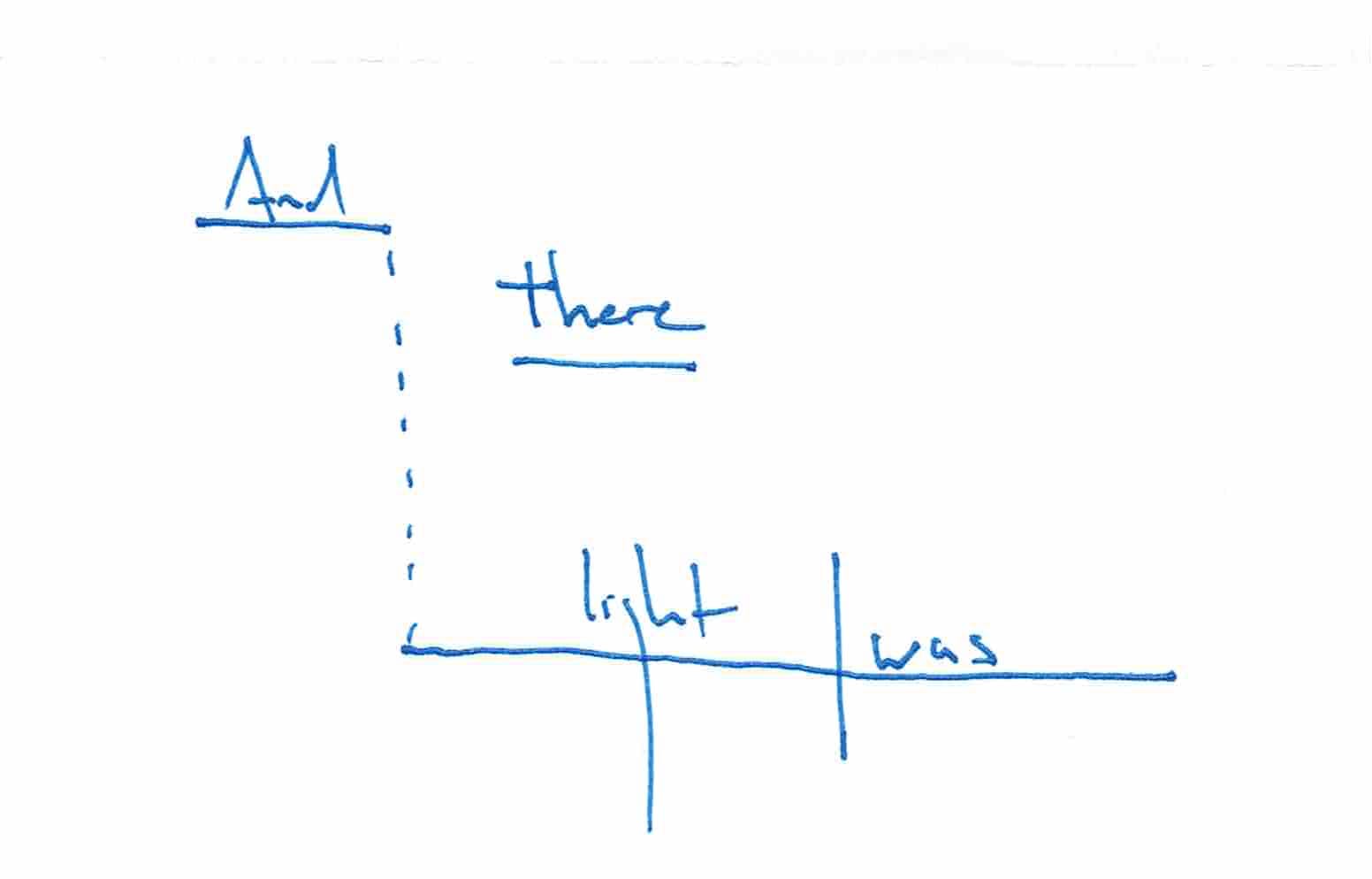
Look at it, floating there.
So, what is in there, this legend?
The poem describes a world seen through the looking glass, in one way or another:
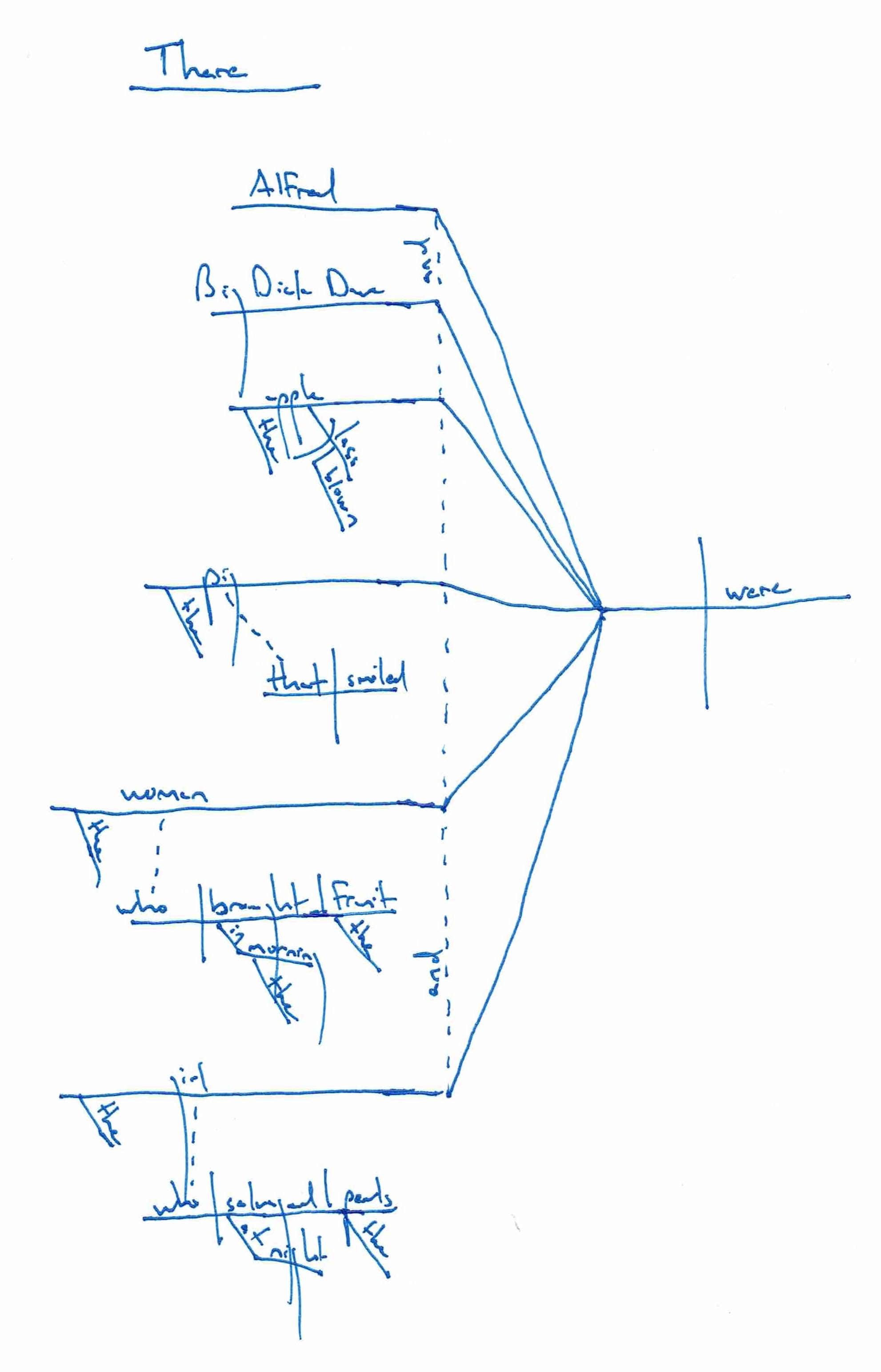
There were Alfred and Big Dick Dave, the blown glass apple, the pig that smiled, the woman who brought the fruit in the morning, and the girl who salvaged the peels at night. There was the writer who didn’t write but lay and scoured his feet many days. There were Gun Man One and Madonna the Fist and the face lightly sketched they passed between them.
Language isn’t working quite like we’re used to. Names, too. Nonetheless, we have a group, and the group is divisible into pairs. Alfred and Big Dick Dave—self-explanatory, good for Alfred. A jolly pig who is perhaps jolly because she is accompanied by an apple that would never be stuffed in her mouth; she is part of the group, not dinner. The woman provides fruit, and the girl collects its waste. Gun Man One and Madonna the Fist, both prone to violence, share a face—maybe a glower, more likely a flirt, I’m just trying to picture it. Divided into pairs, the group has a remainder of one: the writer who doesn’t write but scrubs his feet.
It’s a cast of fantastical characters that makes me think—how butch of me—of a Bruce Springsteen song, “Rosalita (Come Out Tonight).” The singer tries to tempt his lady out for an evening by describing all the antics they’ll get up to. Come on, baby, the whole gang will be there, and all of them have names that make them larger than life: Little Dynamite, Little Gun, Jack the Rabbit, Week Knees Willie, Sloppy Sue, Big Bones—is it Big Bones Billy?! I’ve always, since my youth, heard “Big Balls Billy.” Apparently, I’m not the only one: there’s a webpage that says it’s a common hearing. I thought the monikers for Sloppy Sue and Big Balls Billie were telling us something about what they got up to, that their names referenced each other, characterized their pairing. How cruel to learn the truth at this advanced age, fact-checking this essay. Loop, thank God, gives us the epithet we want.
Epithets like “Big Dick Dave” signal an epic, yes, a legend. We are at once in and beyond time, which gives the poem a sense of untethered freedom. “Almost anything could have spoken but demurred. We revolved like an emancipated fresco, fileted dictionaries by the glib light of day.” Time is spinning rather than progressing. We’re in a painting come alive, in which words don’t need to mean like the usually do. So filet your dictionaries. This there is a place for “colossally vague questions” that “crashed through the open air among distant chirps and hammerings with unvarying frequency.” Which raises the question, where are we? Where is this there?
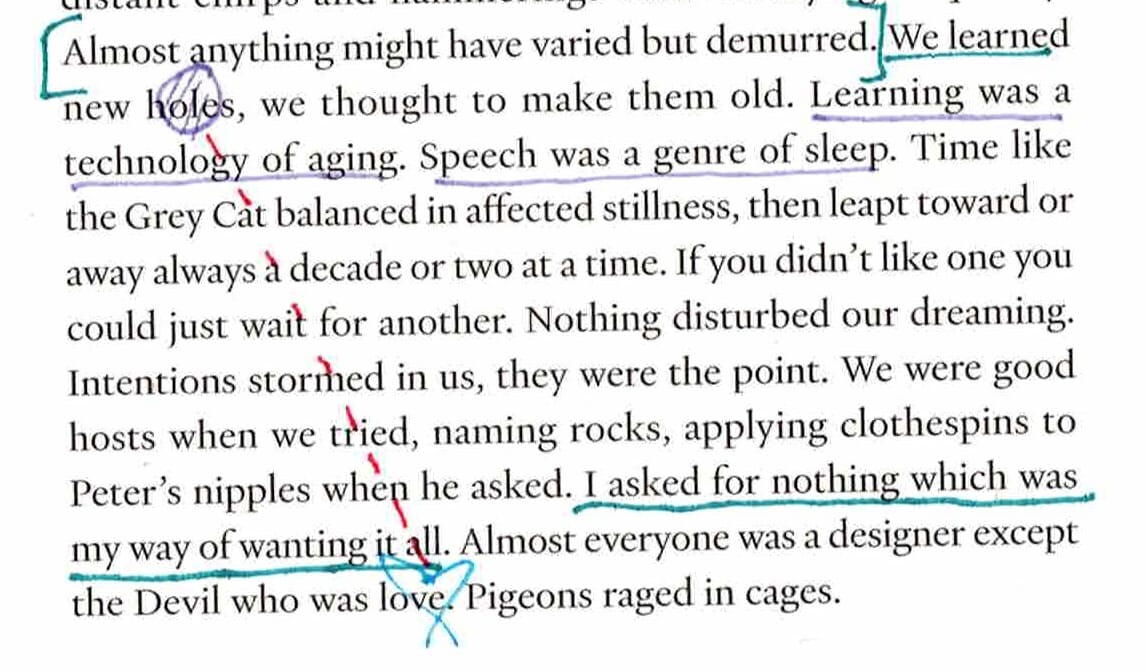
There is a pocket of playful activity somewhere between nature and industry, between birds and hammers. It’s a place of pleasure: “We learned new holes, we thought to make them old.” Words become new things: “Learning was a technology of aging. Speech was a genre of sleep.” And time “like the Grey Cat balanced in affected stillness, then leapt toward then leapt toward or away always a decade or two at a time.” Time isn’t just spinning, it’s bopping around! And our crew with it, along for the ride. “If you didn’t like one [decade] you could just wait for another. Nothing disturbed our dreaming.” The there they share is seemingly imperturbable, a place of satiation. “We were good hosts when we tried, naming rocks, applying clothespins to Peter’s nipples when he asked.” And finally the speaker marks himself present within it: “I asked for nothing which was my way of wanting it all.” This there between nature and industry is a little Edenic: a space in time, but beyond it. A place for naming and for uncomplicated pleasures like eating fruit and squeezing nipples.
We even have a Satan: “Almost everyone was a designer except the Devil who was love.” A love Devil is surprising, but love has to be present. In Metronome, when you see “hole,” look for “love.” It’s usually nearby.
There is plenty of love in our legendary there. More characters appear in subsequent paragraphs, a whole little world. Or worlds, as paragraph four begins: “There were little worlds strung as on a necklace.” The group remains tender, but tempestuous. They have desires and expectations. They have a sense that there is something else, something next, but what are we to do about that? The second paragraph: “We had never been ready for anything our lives, we said, and we would make damn sure not to be starting now. Our expectations were studded with terrible presence. Our expectations were like tables to smoke at.” The existential there is difficult to leave. Wouldn’t leaving be death? Death does happen there: “We sampled cliffsides and regularly died.” That’s the third paragraph. Or the seventh: “Sustenance was a genre of compromise to which the purest of us wouldn’t stoop. They died.” A lethargy accompanies there’s peculiar community, but it is a willful lethargy—a refusal to do what one doesn’t want to do. I think that’s a defensible reading, but now that I write it, I’m not sure.
There is not an Eden. Tension hums within it. There is death, as we’ve established, and even murder with an ice pick. There is isolation, ennui, processed meat. The early hammering that competes with the birds’ chirping hits like an omen. It tells us that the community is permeable, open to the world and others’ intentions. The hammering introduces to “Legend” a preoccupation found throughout Metronome: capitalism’s mechanization and monetization of time. Sometimes, it appears as repetition, as in “We All Work in the Hot Dog Factory Now,” a poem comprised of its title ground up along with moments of life, like a pig ground into a dog. It appears as heterosexuality, a foil for the poet’s faggotry, and as the destruction of language into commodity, the nemesis of poetry.
The legend becomes more and more recognizable as the paragraphs progress. The fifth describes the looming weight of modern life, and the relationship there’s odd little group has to it: “We thought the streets should be books not just more fucking pamphleture. Surely we thought the day approaches when we will not be alone, not encased in little choices, trailing bloody credit off our backs in ribbons, rushed by states away from carven immunities, hoisting a crumbling tablet onto our necks.” Saddest yet, “There was not as much nudity as you might expect.” Debt and pandemic appear. (The There Poems was first published in 2023.) The tablet might be the presence of the law, or it might be one of those tablet computers, the smartphone’s weird cousin. Either way, we’re being surveilled.
Our existential there slowly curdles. Things that seem innocuous or exciting turn threatening: “There was risk, a technology of progress first, and only later, an ancient brutal kindling.” The shift could be risk turning from good to bad, or it could be the people of there waking up to the brutalities of progress. Because our existential there is permeable, we become part of the threatening processes that warp it. That is progress: “We were at work on elastic weaponries to assail the resistless English language. And unpoliceable zones, a manic decade, were abscesses on the culture to house us. We had that. Syllable by syllable and in spite of ourselves we fortified the tendrils of control.” Our actions are, viewed generously, ambivalent. What does it mean to “work on elastic weaponries to assail the resistless English language”? I’m not sure. It sounds bad. It sounds like AI. “Unpoliceable zones,” though, recalls the Capitol Hill Autonomous Zone, a police-free zone established in Seattle’s gay neighborhood in June 2020 after police killed George Floyd. A space beyond police surveillance and rule.
So, it is possible to resist the forces of mechanization and surveillance that limit our lives; nonetheless, we feed them with nearly everything we do, “syllable by syllable.” This essay will be scraped to train LLMs, and I’ll be responsible for feeding it passages of Metronome when I just wanted to tell you about a book I love that a friend wrote.
“Hole” and “love” draw closer together:
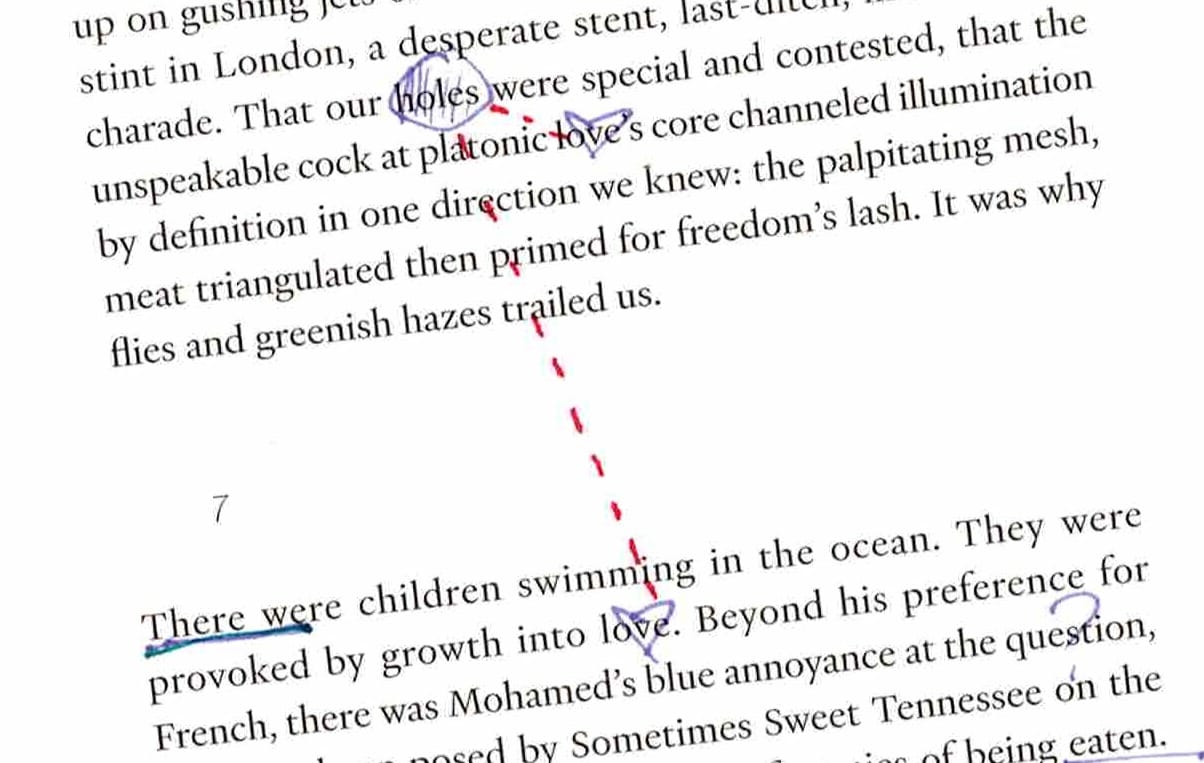
As the poem continues, there remains a place, both real and not. Paragraph eight begins, “There was the problem of not really being there, and its Minister Dissolving, in wig and kerchief number, under whose thumb, diminuendoing, we squirmed.” The poet pokes through his lines, puncturing the text and the there it creates: “There was hilariously James, though it was not per se a laughing matter, in the throes despite himself of an I alone hold the key to this wild parade parody.” The poet draws attention to the fact that this existential there is a prism of his own making. It is a parody, both there and not there. People come and go, entering it and leaving: “though even our sensibilities, of which there were two, had turned degenerated genres of crisis, nevertheless a fresh quiver of sodomites arrived by ferry every morning. Departure remained a meaningful machine.” Sodomites are named by reference to a mythological city that has been destroyed: a there that is not there. Even when it was there, it probably wasn’t there. So of course sodomites flow through Loop’s no-place—we belong there.
Oh—does that mean that the existential there of “Legend” is actually just Brooklyn? It is and isn’t.
“Legend” can be read as a fable of life in Brooklyn or New York generally in the late 2010s and early 2020s, just as it can be read, zooming out, as a fable of life in the US in “those fabled years” when unfettered capitalism followed itself into fascism.
The final two paragraphs see the threats to their end in there. Nine begins,
There was an alarm accumulating in the margin, resolve flagging in the wings. The green river, like a slender nationalism, rose. Some stayed and took their chances, went recessive, raveled days around the speaking spindle, painting bandages onto framed space. Others decamped, ground illusion down to the piratico-pragmatical pyrite virtue particulate at the bleached millstone.
The fable chafes against its genre. A river rises like nationalism, but simply naming nationalism makes the simile that is the veil between fable and reality thinner than paper. Some stay there and weather the rising river, pretending that it is something other than what it is, while others leave, seeing this fable as nothing but fools good. The pastoral crumbles. Paragraph ten says, “There was no way around there being no time left, if by time was meant this percolated tedium, this radiant bruise left by fruitlessness’s sweet grip.” The plague was here, now. “The city, believe you me, was dirty drained, and florid.” Still it offered “meager armor,” the sense of a future, “its tomorrowishness.”
What’s seen can’t be unseen. We are not removed from time, not removed from history, not floating above it all; we teem within it. We are it. The existential there of this legend is a slipcover for our here. And we participate in the awful things here. This disillusioning knowledge is a scratch.
The speaker speaks of a scratch, perhaps on the psychic armor afforded to city dwellers who buy into the myth of their urban romance: “Though we continued to enjoy the meager armor afforded us there, its tomorrowishness, though we had long accommodated ourselves to its alphabet’s pellucid havoc, the scratch itself was opaque and clearly fatal.” The armor is the legend and the armor is scratched. The story has holes in it.
The paragraph curiously breaks into dialogue about the scratch, without quotation marks to differentiate between speakers: “A scratch. Did you really have to travel so many miles only to see it. Seeing is my heritage. For God’s sake then why did you bring it here. I bring it everywhere. There was nowhere to put it down when I started out.” The conversation is either between someone who lives there and someone who has recently arrived there or between the speaker and himself. They came to see the scratch, but may have also brought it with them. The scratch is part of the city there, but something we can’t help but take with us. If this there were an Eden, the scratch is the bite in its glass apple, its original sin.
Although the scratch punctures the pastoral fable that makes life more comfortable, more whimsical, the scratch allows one to see what is, peeling back myth like a cuticle. “For in the base of this glass, a scratch, I see a new town glimmering, a scratch, a scratch, awaiting our petty drapery, a scratch, whose oceans clank and whir.” Is this a hopeful vision? It is and it isn’t. It’s a vision seen through an empty glass—not a looking glass; one with a base—so we’ve been drinking something or other. There is a new town, yes. It glimmers, yes. When we reach it, though, we will bring our same “petty drapery.” It isn’t much to go on, but drapery conceals. Even when a clearer vision is possible, we cover it up.
“Legend” begins in a whacky pastoral, a no-place, an existential there, filled with people occupied with their loves and expectations and intentions, not maliciously preoccupied, but still, their there is revealed to be a myth, a legend. It can’t keep its residents safe from history, which appears in a plague and like a plague, like surveillance, like every word bent toward control.
On my first read of the poem, my primary response was a sense of something ominous encroaching. The paragraphs are packed with so many strange details and turns of phrase that I wasn’t quite sure what was happening. My explication here could be too heavy handed, too willing to pick some details over others, but it gives an account of the trajectory I encountered within the poem.
If that’s there, what is here?
I had hoped to write a more birds-eye view of Metronome, but I slipped further into “Legend” than I intended. It is an enveloping poem. I might follow up with an essay on Here, which, although taking its name from a series of poems Loop wrote in Italy and thus further from his Brooklyn home than “Legend,” is franker and more intimate—closer, here. There is much more to explore in Metronome about the ways language is changed in poetry and by capitalist monotony.
In the meantime, thank you to James for writing this book, and congratulations! Metronome has quickly become one of my favorite books of poetry: an impressive debut with a fully realized and versatile voice that goes here and there but keeps its time throughout, consistent in quality. No skips.
Oh my God that description was so commercial. So, let it be commercial: Buy Metronome here.
In the coming months, there will be contributions by some excellent non-me writers. If you would like help me turn The Rearview into a publication that regularly features the brilliant voices of writers I admire, please donate to Homodoxy.