The Injustice of Zionism
by Edward Bliss Reed (1920)
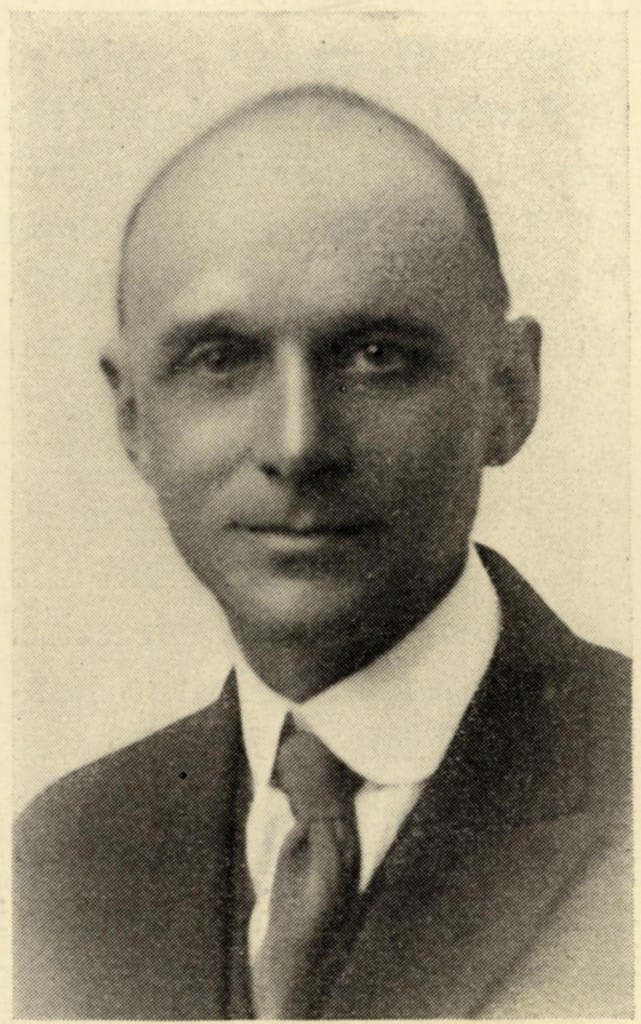
This essay was first published in The Yale Review in April 1920. Per the terms of Chapter Three of the Copyright Law of the United States (Title 17), December 2022, section 304, it is now in the public domain. The Rearview shares it as a Rearsource to accompany “Miseducation: on learning and not learning about Palestine.” A few spellings have been updated. Instances of prejudiced language have not been modified.
Of all the questions which the Peace Conference faced, none has proved more difficult than the intricate problems raised by the collapse of the Turkish Empire. It is not because the Allies are waiting to see whether America will assume a mandate in the Near East that peace with the Sick Man of Europe has been long delayed; it is rather because more European interests clash in Turkey than in any other part of the earth. The last treaty to be signed will be one that must adjust the rival claims and aspirations of Armenia, the new Arab kingdom, Greece, Italy, France, and England—to say nothing of the Turks themselves.
To the world at large, the clashing forces are purely commercial and political; yet great as they are, there remains a question arising from the downfall of Turkey that will eventually arouse as keen an interest as any of the, much debated territorial adjustments of the war. The ultimate fate of Palestine will concern every Christian, Jew, and Muslim, for all see in that country a Holy Land, all feel a peculiar interest in it such as they have for no other foreign soil. It is strange, then, that so little serious attention has been given to Zionism and its aims. The subject is a thorny one because it involves not only politics and religion but the questions of nationality and of a race prejudice combating a race assertiveness centuries old. Yet Zionism must be discussed frankly, above all in America, because Americans, whose national weakness is sentimentality, do not clearly understand what this movement implies and whither it inevitably leads.
Reduced to its simplest terms, Zionism is an organized movement to make of Palestine (an Arab country) a Jewish state or commonwealth. Since at present there are about eighty thousand Jews among the seven hundred thousand inhabitants of the land, it is essential for the establishment of this Jewish national home that Jewish emigration to it be not only encouraged but fostered and subsidized by organizations outside of Palestine. Funds must be raised in Europe and America, and Jews must be sent back to their ancient heritage. When they arrive by the thousands and tens of thousands from all over the world—but chiefly from Romania, Poland, and Russia—then the work of Zionism will be to educate and weld these descendants of the twelve tribes into a unified whole which shall be the new Jewish nation.
This re-creation of a Jewish homeland, this second conquest of Canaan, the Zionist regards as the prerogative, the vested right of his race. If this right should be challenged, he advances two claims, one of which we may call the historical justification of Zionism, the other, the biological argument. The Zionist presents them as follows:
The historical claim is a twofold one. In the first place, the Jews once possessed the land and on the soil of Palestine they reached that spiritual development which has made the whole world their debtors. It is true that two thousand years ago they lost by the sword that which they held solely by right of conquest; yet a saving remnant of the faithful have remained in Palestine from the day the tenth legion battered down the inner Temple wall, from the day, sixty years later, when the hill fortress of Bittir was stormed by the Romans and the last vestige of the Jewish nation disappeared, until that historic hour when Allenby entered Jerusalem. No matter whether Roman or Arab or Turk has ruled the land, the world has always known it as the home of the Jews, and they must return to their old home. Moreover in the deepest sense—and this is the second part of the argument—the Jews have never really lost the country, for it has been their spiritual abiding place. Scattered to the four corners of the earth, they have never ceased to turn to Palestine and the city of David in their prayers, their services and their feasts of the Passover. One may see any day at Jerusalem a little handful of mourners gathered at the wailing place of the Jews, at the foot of that wall which once may have formed part of the Temple. They are but a symbol of the whole race that can never forget its past.
From the Psalms of David to the Hebrew lyrics of the Austrian Imbert, the Spaniard Halévy, the Russian Frug, the prevailing theme is the same: a passionate love for the land of Israel and the unquenchable desire of the exile for his home. In dreams and in hopes the Jews have trod their land again; they have made it theirs by a conquest of the soul. The promises of Jehovah have never been revoked; and the verse, “Ye shall dwell in the land that I gave to your fathers,” is for the Zionist, orthodox or free thinker, no empty phrase but rather an expression of his deepest conviction.
The biological argument is simply the right of a people to live. Persecuted for twenty centuries, even in the most tolerant communities the Jew can feel distinctions drawn between himself and his gentile neighbors; he finds barriers (if only social ones) constantly obstructing his path. In Russia, he faces not a thinly disguised snobbery, but plunder and pillage, injustice that often leads to death. In more than one country of Europe racial hatred is deliberately fostered, and the close of the war has not brought to an end this long martyrdom of a people. If states are created for the Poles and the Jugoslavs, there must be one for the Jew as well. Too long has he been exposed
To daily fraud, contempt, abuse, and wrong,
and as Christendom has not given him fair treatment, it is his duty to create a world of his own, in which he can be a free citizen and in which all his energies may have free play. In Europe and America he has never wholly been at home; in his own land he will slough off whatever faults centuries of persecution have forced upon him; the Hebrew genius will again assert itself, and the whole world will be the gainer.
The new Jewish state will develop the highest qualities in the men and women who return to Palestine, yet they can be only a small part of the race. According to the Zionists, it will reach even those who by choice or by necessity remain forever in the dispersion, for it will become a spiritual center that will refresh and strengthen Jewry all over the world. Zionist writers speak with concern of the “disintegration” of those Jews who live in non-Jewish communities. According to Dr. Weizmann, one of the leading figures in Zionism, modern culture and ideas are a “powerful solvent of established Jewish belief and custom for which they substitute nothing that is distinctly Jewish but only (at the best) a broad universalism which means in practice the adoption of the national culture nearest at hand.” The Jew loses his race consciousness, and absorbed in his environment, he forgets his inheritance. Zionism will check this process of “disintegration” and save the Hebrew folk, for every Jew will take a new pride in his race and will resist the levelling influences of his surroundings when once he has a national home. Thus this movement will rescue not merely the victim of the European ghetto, but the cultured Jew of London and New York. It will revive every part of the Jewish people, and those who return and those who stay will feel its inspiration and guidance.
Zionism is not a faith without works.
Zionism is not a faith without works. To quote Dr. Weizmann once more, the organization has two hundred thousand adherents in all parts of the world; it holds biennial congresses which formulate plans for its advancement; it maintains “a network of financial institutions, its press in many languages, and its incessant and extensive propaganda by the written and spoken word.” It has enough political power to obtain from Mr. Balfour his famous statement that “His Majesty's Government views with favor the establishment in Palestine of a national home for the Jewish people,” though he qualified this with a phrase which Zionist plans have overlooked, that “nothing shall be done which may prejudice the civil and religious rights of non-Jewish communities in Palestine.” It brought to Paris, to work for it at the Peace Conference, an Associate Justice of the United States Supreme Court, and it has called forth from President Wilson, whom Rabbi Wise has termed “the greatest friend Israel ever had,” the opinion that Americans are favorable to Zionism and agree that in “Palestine shall be laid the foundations of a Jewish commonwealth.” It has subsidized and developed in Palestine some fifty “colonies” with fifteen thousand members, and in 1916 it held thirty-four thousand acres of land suitable for additional settlements. It has shown in these “colonies” that with modern methods of farming, the land is a fertile one and can be tilled profitably.
On the cultural side, Zionism has started a successful revival of the Hebrew language; it maintains elementary and high schools; it has organized centers of technical and agricultural training; and it has even made plans for a university on the Mount of Olives. This movement is at the same time practical and idealistic. While it contemplates the cleansing of the Jerusalem slums, it dreams of building a model state free from “the economic wrongs, the social injustices, and the greed of modern industrialism.” It has founded orphanages and hospitals that minister not to the Jew alone, but to Christian and Muslim alike; and it has brought to maintain them men and women highly qualified for their work both by their spirit of devotion and their technical training. The Jewish immigrant is more industrious and progressive than the Arab or Syrian. Give the land to him, and he will labor in it as no other race can, for it is dearer to him than to any other. He will restore Palestine to its ancient splendor, and the leaves of the tree shall be for the healing of the nations.
To one unacquainted with the Near East, this argument is not merely plausible, it is convincing when the Zionist assumes, as he generally does, the role of the prophet and depicts the transformation of Palestine, unpeopled and untilled, into the fabled land of milk and honey. When production is the superlative need of the hour, it is surely a benefit to the world if a desert can indeed be made to blossom as the rose. “Why should not the Jews return to their old home?” is the easy phrase with which the average American dismisses the whole complicated question. The danger and the injustice that such a return involves, he does not consider because he does not suspect it. It is this side of the question that we must now examine.
At the Paris Peace Conference the Zionists submitted certain demands which included a recognition of the “historic title of the Jews to Palestine” and “the right of the Jews to reconstitute Palestine as their national home.” However great the appeal of sentiment and the achievement of the past, it is apparent that the Jews possess no title to that country and that the historical argument which we have summarized is valueless. The twelve tribes invaded Palestine, won it by hard fighting, and finally lost it to the Romans. The Arabs have possessed it for a longer period than the Jewish nation ever held it. In the reigns of James the First, Charles the First, and Charles the Second, many English men and women were forced by religious persecution and civil war to abandon their homes and to seek a refuge in this country. Should their descendants, now numbering scores of thousands, ask that their “historic title” to English lands and estates from which their ancestors had been driven three centuries ago be recognized today, it is quite clear what the answer would be. The Zionists go back in their claims not three hundred but three thousand years, to the Kingdom of Solomon. Obviously no race or nation can presume to remake, to its own advantage, the map of the world as it existed a thousand years before the birth of Christ.
The boundaries of the proposed Jewish commonwealth are comprehensive. Leaving aside the claims of those Zionists who talk of the greater Palestine, or, in other words, aim to control Syria also, the most moderate of the proposed boundaries extends as far as Akaba. This town, situated on the gulf of Akaba, a branch of the Red Sea, and lying further south than Cairo, is desired for purely commercial purposes, as a port for the trade of Persia and India. On the north, the line extends through Phoenicia, though French poilus are in Tyre and Sidon and that whole district is apparently to pass under French control. On the east, the Hedjaz railway, built by the Arabs to take pilgrims to Mecca, is now taken as the boundary line. This railroad runs north and south, some thirty-five miles on an average beyond the Jordan; but all the land east of that famous river has been taken over by the new Arab kingdom. Plainly, if there were no burning question within the proposed state itself, its boundaries could not be decided by simply presenting at Paris certain demands formulated by Zionists. Evidently it is not a question of what a Jewish nation once governed, but what Zionism considers would be most advantageous both politically and commercially for it to hold at present. There is no validity in the historical argument.
Naturally the question to be asked first of all is what the Palestinians desire.
What we have called the biological argument is equally unconvincing, and we must dismiss it in a few words, for we have not approached the heart of the whole matter. It is admitted that the new Jewish commonwealth can never hold more than a small proportion of the race. Millions must still live in Europe, where pogroms will not cease because some hundreds of thousands of Jews have emigrated to Judaea or Galilee. Zionists and Christians must unite in attacking injustice and cruelty in whatever so-called Christian countries they show themselves. A Jew must live and work in safety in every country; and toleration, equality, and justice are in no wise dependent upon the success or failure of a Jewish state.
Thus far we have left out of consideration the point on which the whole problem should turn. Since Palestine is an Arab country in which the Jews are outnumbered eight to one, naturally the question to be asked first of all is what the Palestinians desire.
To the American mind, the founding of a Jewish commonwealth in Palestine is comparable to opening up Indian lands and establishing the State of Oklahoma, but no such parallel can be drawn. Apart from the small proportion of Bedouins, the Arabs of Palestine are divided into two classes. The fellaheen, the village or farming class, are ignorant, absolutely illiterate, and show all too plainly the result of four centuries of Turkish oppression, yet these very Arabs can make good agriculturists and to the number of five thousand have largely furnished the labor in the Jewish “colonies.” Indeed, it may be said that without them, the success of these Jewish communities would have been extremely problematical. The second class of Palestinians, the business men, the employers of labor, contains many well-educated Arabs, both Muslim and Christian. It is no long journey to Beirut with its American college where Christians and Mohammedans receive a training equal to that given by our best institutions of learning. Both classes have lived under the tyranny of the Turk, who discouraged education, forbade progress of any kind, and deliberately retarded the development of the country. Now that his yoke has been removed forever and for the first time Palestinians may look forward to living and working under a just government, the chief question to be asked is how they feel towards this new commonwealth of non-Palestinians to be forced upon them by Europeans and Americans. Surely if the principle of self-determination means anything, it implies that the inhabitants of a country shall have some voice in the government and development of their own land.
Unfortunately, no voice from Palestine ever reaches our shores; instead we hear what Dr. Weizmann has called the “incessant and extensive Zionist propaganda.” “Zionism and the Jewish Future” is a collection of characteristic essays by leaders in this movement; no chapter in that volume discusses what the vast majority of Palestinians feel in this matter. The Zionist either prudently avoids this question or he passes over it with the vague assertion that Jew and Arab, belonging to sister races, will become fast friends because of mutual interests. At times he makes the mistake of expressing himself as did Professor Israel Friedlander, whose remarks are so typical of certain aspects of the Zionist propaganda that they must be cited:
But is it true that these 630,000 Palestinian Arabs are ‘unanimously’ opposed to Zionism. The fact of the matter is that the Mohammedan Arabs of Palestine, forming nine-tenths of the Palestine population, have heretofore been in favor of Zionism, seeing what the Zionists under most adverse conditions have already done for the rejuvenation of their desolate land; and the Greek Orthodox Christians, who form an overwhelming majority of the Christian population in the Holy Land, have repeatedly expressed themselves in the same manner. . . . Those Arabs who have spoken against Zionism are as a rule non-Palestinian, inhabitants of Syria and Egypt, who have no right to speak for the Palestinian natives.
Two incidents that occurred after Professor Friedlander had written that statement will show the actual situation. In March, 1919, a group of Zionist immigrants landed at Joppa. Rumor placed their number anywhere from two hundred to two thousand; there were perhaps some five hundred in the party, yet this mere handful, compared to the coming hundreds of thousands, was enough to crystallize in Jerusalem the determined hostility to Zionism that exists there. Muslims and Christians, not always united, planned together an anti-Zionist demonstration to take the form of a procession through the city. It was hoped that this would show the outside world what Palestine thought of the proposed commonwealth. Anticipating serious trouble, the British authorities brought battalions of Indian troops to Jerusalem and demanded guarantees that no disorder should result from this public protest against Zionism. Certain leaders were told that they must assume responsibility that no outbreaks would occur, and as they were unwilling to do this the whole affair was suppressed. No demonstration was held, but at least the non-Jewish citizens of the capital of Palestine were shown unmistakably to be thoroughly opposed and even hostile to Zionism.
On this side of the Jordan, not far from Jericho, is Nebi Musa, where the Muslims venerate (and not at Mt. Nebo) the supposed grave of Moses, a mighty prophet in their own tradition. Some centuries ago, for purposes of political and religious propaganda, the Arabs instituted an annual pilgrimage to it, hoping to rival in some degree the Christian ceremonies and services of Easter week and to stimulate national feeling. Last April the pilgrims gathered at Jerusalem, coming not only from the city but from the surrounding villages, from fanatical Hebron on the south to Nablus on the north. Their green banners were carried to the Dome of the Rock and blessed, and the procession, led by the Grand Mufti and other Muslim officials passed through St. Stephen’s gate and took the Jericho road. The greater part of the city had gathered on the steep slopes of the Kedron valley to watch it pass. The municipal tent from which the Arab mayor and his invited guests reviewed the pilgrims and heard the songs of the Arab boy scouts was pitched at the end of the Mount of Olives, where the Jericho road bends eastward towards Bethany. From the bridge over the bed of the Kedron as far as the tent, the Muslims walked through two lines of Indian troops, standing with fixed bayonets. It is true that under the Turkish régime troops were furnished to lend the pilgrimage a certain éclat, but on this occasion the battery of eighteen-pounders, brought to Jerusalem ostensibly to fire a salute, and the airplanes once more hovering over the city, showed that the presence of the soldiers meant something more than a picturesque addition to a spectacle. Every precaution had been taken that the national spirit of the Arabs, aroused by song and speech, should be kept within bounds. That anti-Zionist outbreaks have not occurred by this time in Palestine is due solely to the vigilance of the British authorities.
The very month that Professor Friedlander was assuring American readers that there was no opposition to Zionism in Palestine, the Muslim-Christian Club of Jerusalem, representing scores of prominent citizens, cabled to the Paris Peace Conference a long petition, submitted in behalf of the whole of Palestine. This vigorous document stated that members of this organization had been deeply wounded by the newspaper accounts of the appeals made by the Zionists to the Peace Conference “because they give the truth a different color and pretend that they are the owners of the soil.” It emphasizes the fact that Palestine is Arab, not Jewish, and that out of twenty-five thousand square kilometers of agricultural land but three hundred and fifty square kilometers are held by Jews. It insists that the rights of the majority cannot be disregarded; it charges Zionism with arousing religious fanaticism; and it closes with the following emphatic statement: “We are confident that the Allies and the Peace Conference will establish our obvious rights in our country, reject the Zionist claim, and prevent Jewish immigration which dissipates [sic] the Arab nation from its country. This country they will protect by all possible means and will defend to the last drop of their blood.” The last phrase is high-sounding enough, yet it will be a mistake to dismiss it as merely Oriental hyperbole.
To anyone who has read Zionist literature, it will be perfectly obvious why such a petition was sent. For example, Mr. Sidebotham writes, somewhat naïvely, that Zionism desires “to encourage Jewish immigration by every means and at the same time to discourage the immigration of Arabs”; or to put it in other words, the nation that owns the land must be kept out of it while aliens are to be encouraged and even subsidized to come in and possess it. It may be said without exaggeration that such a plan hardly offers a rosy future for the young Palestinian. Much in the same spirit, the London Zionist Conference opened a Central Palestine Office to determine what “economic, administrative, and other conditions are needed for the incoming large-scale colonization of Palestine”; and it promised to hasten the time when the largest possible exodus to Palestine could take place. It appears rather extraordinary that an English committee in London should presume to decide just who should be admitted to the Holy Land and under what conditions. The majority of intelligent Palestinians react to such statements as would a Californian were he told that his State was to become a national home for the Japanese and that any questions concerning immigration would be regulated at Tokyo. In one respect the parallel is not accurate: the Arab is more temperamental and explosive than the American.*
Zionists have asserted that whatever opposition exists in Palestine will rapidly disappear when the non-Jewish population understands it is to have a large share in the blessings which Zionism will shower upon the country. Naturally, roads and schools, reforestation, better sanitary conditions, asylums and hospitals—good works in which Zionists have been leaders—will benefit the entire land; but the Arabs understand perfectly that the proclaimed object of the movement is to gain control of their country. This can be accomplished only by gradually dispossessing its inhabitants of both land and trade. Instead of bringing prosperity, the Zionists have brought unequal competition, for their “colonies” have been assisted over their bad years while the native farmers and artisans have had no one to compensate them for their losses. At their own banks the Zionists may borrow money at a fair rate of interest; the Arabs have had no national banks but have been compelled to borrow from the Turks at highly exorbitant rates. The economic struggle is hardly an even one when the foreigner has back of him in his enterprises an organization that plans to raise in one year in America alone ten millions of dollars, while the native, up to the present, has had no capital to assist him.
It is a common statement that Zionism means a return to the soil, and, as we have seen, the Zionists have established some fifty farming communities and plan for many more. “When you come to Palestine,” says one of their writers, “you will be what you were formerly: farmers, shepherds, gardeners, but never merchants.” Undoubtedly, if unrestricted immigration were allowed, tens of thousands of Russian Jews would till the soil, but it is nevertheless evident that the Zionists desire to exploit the country. To quote from one of their own engineers, they see railroads to be constructed and the “tourist industry” to be so organized that Palestine will become another Switzerland or Riviera. The swift flowing Jordan will be harnessed to supply light for cities and motive power for factories; the Jordan valley will be irrigated; the untapped store of chemical wealth of the Dead Sea will be transformed into gold; coal, iron, and copper mines will be opened; and oil wells will spring up in what is now desert. The traveler is always selfishly conservative; to satisfy his dreams he wishes Palestine to remain as it is—in many ways not greatly changed since the days of the Apostles. As he walks up from Bethlehem in the cool of the evening, he would rather meet an Arab singing as he marches beside his heavily laden camel than a Bedouin, in a ready-made suit, rushing by on a motor cycle. Yet Palestine must change and change rapidly; its resources will be developed and the present inhabitants wish to lead in the changes.
Americans can readily understand the attitude of China towards Japan when it comes to the question of the control of Chinese harbors, railroads, and mines by the Flowery Kingdom; the Palestinians have the same attitude towards Zionist colonization and exploitation. One of the requests made by Zionism at the Peace Conference was that the mandatory power governing Palestine, presumably England, should accept the “co-operation” of a Council representing the Jews of Palestine and the world, giving to this Council any concession for public works or the development of natural resources. In such a preposterous demand may be clearly seen the foundation upon which Zionism is based—special privilege.
Apart from the political and economic injustice of Zionism, there is another question whose serious aspect the American cannot understand because he is tolerant both by education and conviction. In Palestine the question of religion—or what is called religion—is all important. Rightly or wrongly, it is feared that a Jewish state, despite promises to the contrary, will eventually seek to recover its historic landmarks, the places where Jewish history was made. Apart from the sites of ancient towns and cities, there are perhaps only three places whose authenticity is thoroughly established: Jacob’s well at Nablus; the Temple area at Jerusalem; and the cave of Machpelah at Hebron. Nablus is the ancient Schechem, the chief city of Israel long before David won Jerusalem. To-day it is so thoroughly Muslim that when Allenby’s army captured it, there was a question whether or not Christian troops in any number should be quartered there. On the Temple area stands one of the most beautiful buildings in the East, the blue Dome of the Rock, resplendent with its colored tiles, the gift of Soliman the Magnificent. It holds the huge stone that may have been the altar of burnt offerings; surely a part of the Temple once stood here, but Muslims hold it now, and to them it is the third most sacred spot on earth. The cave of Machpelah where lie the father of the faithful and Sarah, his wife, where rest the bones of Isaac and Rebecca, is beneath a mosque in one of the most fanatical of towns. Until the war, only Muslims crossed its threshold; even the late King Edward, armed with a firman from the Sultan, was in danger of attack when he entered the building. On the Christian side, Bethlehem, prosperous and fertile, the town of Jesse and of David, of Joab and Abishai, of Naomi and Boaz, has not a single Jew living within its walls, so strong is the feeling on both sides. These places which mean so much in Jewish history and tradition are and will be centers of resistance to Zionism; and when in addition to political and social hostility religious fanaticism is aroused, the result is disastrous. It is no baseless surmise that if the extreme claims of Zionism are granted, the most hateful of all conflicts, a religious war, may sweep over the country which gave the world the message of peace and good will.
To sum up the whole matter, Zionism does not offer a just settlement of the Palestine question; that can never be reached by hearing simply one party, whether it be Jewish, Christian, or Muslim. The fate of this country is not a matter for Zionism to settle, for it affects the whole world. Three great historic religions turn to this small land; for, though small, it is too large for any one race or religion to lay claim to it. If the Jews once fought for it, so did crusading Christians, and the soldiers of Saladin. It must be a land whose destiny is decided and whose future is won by its own people. It must be assisted to work out its own salvation; it should not be forced to accept a society, a culture, a government thrust upon it from without. Peace and justice are the great desire of that land which itself has been the desire of all nations. Surely the world will see that peace and justice are granted her.